Tuesday, February 03, 2009

On Newspapers

I represent one of those dying cultural anachronisms. I still value, no, cherish, the newspaper. I read a number of newspapers online, and get the vast majority of the information I consume on the internet, to be sure. But I still value the daily newspaper, whether it is the Odessa American delivered to my door every morning, The New York Times delivered on Sunday, the San Antonio Express-News when we are down there, or the ritual of making sure to grab the local paper when I am traveling, unless it comes to the door of a hotel room, which is always a nice surprise.


I grew up reading my local paper and The Boston Globe that my stepfather picked up every day. Without descending into cliche, I love the tactile, tangible element of the daily paper, and I do believe that there are things you catch while reading through the newspaper that you do not when browsing the handy headlines and choosing what to click on when it arrives in your email inbox.


But we keep hearing that the newspaper is dead, and all signs certainly point that way. I hope something happens to salvage the print newspaper, but within a generation I would guess that the daily paper will be greatly diminished, if not an entirely defunct species. In the latest New Yorker, Harvard historian Jill Lepore (whose regular work there is fantastic) has an article on early American newspapers in which a subtext is that the medium's very survival was always in question. The goal may be to reassure, though the realities of this market are rather different from the colonial and early national era. It may not be entirely reassuring, but her piece will at least remind you of the resilience of the daily (or weekly) printed word.

Monday, February 02, 2009

The Somali Terrorism Connection

Are terrorists recruiting Somalians living in the United States? It appears so. And if so, for what purposes and to what ends? There is not enough here yet to draw firm conclusions, but there is enough to recognize that instability in the Horn of Africa has created ripe conditions for terrorist recruitment.

Friday, January 30, 2009

The First FML Review: Self Indulgence Alert

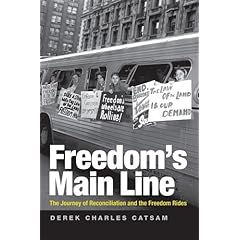
I received my first review (alas, already archived, so you'd have to pay for it) of Freedom's Main Line. The review appeared in the Chattanooga Free Press and is overwhelmingly positive, so I'm thrilled. The press will send out reviews and such once a month, so it would have been a real bummer to have to sit on a negative review for several weeks. here is the closing paragraph of the review:
Catsam, in compiling a fascinating history is not presenting solely black history or Southern history or civil rights history. he is presenting an ever-evolving American history, a concept underscored by the presentation of the book and reinforced by our recent election, which has presented us with a moment to look back and forward to the next stage of "Freedom's Main Line."

Yeah, I can live with that.

Not For Vegetarians: Friday Goodness Alert

Take loads of bacon and as much pork and what do you get, other than yummy awesomeness? A glorious new epicurial phenomenon known simply as The Bacon Explosion. Go. Make it now.

Thursday, January 29, 2009

RIP, John Updike, Baseball Fan

John Updike, a colossus in American letters by any measure, died Tuesday. He was 76. Updike was a baseball fan. And he contributed what is almost certainly the greatest single essay about the sport, an impressive accomplishment given the deep interconnections between baseball and writers. "Hub Fans Bid Kid Adieu" is a paean to Ted Williams, Fenway Park, and the game itself.


What a lousy week this has been for book lovers.

RIP Book World

The rumors are true. The Washington Post is abandoning the Sunday Book World as a stand-alone section and will be integrating it with other sections of the newspaper. This is terrible news for book lovers and especially for those of us who feel that serious writing about books is important.


When I lived in Washington, and whenever I travel there, which is fairly regularly, I have always looked forward to Book World as a staple. It always provided a non-New York centered look at books, and often was every bit as good as its New York Times counterpart, and on some Sundays could be significantly better. Much will be lost in this transition. And virtually nothing gained. I'm not quite in mourning. But I'm also not far from it.

Gladwell Takes a Beating

If you like a good old fashioned literary beatdown (and you know that you do) you'll thoroughly enjoy Isaac Chotiner's recent evisceration of Malcolm Gladwell's new book, Outliers that really serves as a repudiation of Gladwell's entire ouevre. I tend to enjoy, but not place a great deal of stock in, Gladwell's magazine articles, but have not yet read any of his books, two of which are sitting on my bedside shelf to be read at some future date. I have been uneasy about what I have read about the books, and Chotiner's review does not do much to soothe my wariness. But it sure is fun to read! Mean stuff so often is.

Misusing Quotation "Marks"

If you have ever graded student papers, or simply had to wade through a lot of bad writing, you've seen it: The profligate quotation mark. The single-most common comment I probably make on student papers is to circle unnecessary quotation marks and ask: "why"? This might become required reading for my students. (It will go along with this reminder, which I pointed out a few weeks ago, that the inapt quotation mark can also be used hamhandedly for ideological purposes.)

Saturday, January 24, 2009

Virginia Festival of the Book (Self Indulgence Alert)

I will be participating in this year's Virginia Festival of the Book on a panel called "Stories from the Civil Rights Movement." My panel is on Thursday, March 19th, at noon at the UVA Bookstore. It probably goes without saying that I'll be promoting Freedom's Main Line. But I'll say it anyway. (And yeah, that's the worst picture ever.)

A Difference of Opinion on Oscar

My goodness, how's this for diametrically opposed views on the just-announced Oscar Nominations?: They either mark the triumph of quality or a tremendous disappointment that reflected a bad movie year. Because of the late-year timing of virtually all of the best picture nominees, and their even later arrival here in West Texas, this is the first year I can ever remember when I have not seen a single best picture nominee by nomination announcement time.

A Little Tearjerker

If you are an animal lover the fact that you know what's coming will in no way soften the blow when you read this Sportsguy story about "Dooze," his beloved family dog.

Friday, January 23, 2009

At the FPA Africa Blog (Self Indulgence Alert)

Just a quick note to direct you toward the Foreign Policy Association's Africa Blog where I have been busy covering a whole host of events ranging from Somalia to Guinea to the Democratic Republic of the Congo and beyond, and of course lots of coverage of the Zimbabwe crisis and South African politics. Please check it out.

Baseball 'Round the Corner

On Valentine's Day pitchers and catchers can report for spring training. Thus the countdown can begin soon. Now is as good a time as ever to point out that the American League East race is going to be epic in 2009.

The Best of Rickey Being Rickey

In honor of Rickey Henderson's induction into the Hall of Fame, here is an amusing ranking, from a few years back, of the Top 25 Rickey Henderson moments. Suffice it to say I'm looking forward to that speech in the summer.


Hat Tip to my buddy Bill.

Thursday, January 22, 2009

Claiming Credit While Not Taking Blame

The Bush administration and its advocates like to point out the lack of any terrorist attacks on American soil after 9/11 as evidence of a crowning success in President Bush's Global War on Terrorism. Former Bush speechwriter Marc Thiessen argues as much in today's Washington Post. The argument is fine as far as it goes. In the wake of 9/11 many observers -- myself included -- expected other attacks to follow. They did not. Whether this is the result of Bush policies or an inability of al Qaeda (or anyone else) to follow up on their massive undertaking on that awful September morning is up for debate. But it is true that no attacks followed the terrorism of 9/11.


However, it seems rather shortsighted to simply look at that fact and claim it as a major accomplishment. After all, the Clinton administration went even longer without an attack on US soil from foreign terrorist groups after the first World Trade Center bombing in 1993. Furthermore, how is it possible to take credit for a lack of attacks after 9/11 without at the same time acknowledging that the administration did not stop the worst terrorist attack in American history? Bush's advocates cannot possibly have it both ways, denying any responsibility whatsoever for not preventing 9/11 but claiming a lack of attacks after 9/11 as the result of successful policy. 9/11 happened during the Bush presidency. That is an immutable fact. The failures on 9/11 were systemic, to be sure, and blaming Bush, or blaming Clinton, would be largely pointless. Until you start using the lack of attacks as a political chit. At which point, the rules of the game change.


Finally, the United States has allies. In part as a nearly direct result of their coordination with American policies, Spain and England suffered terrorist attacks after 9/11. (I was in England on the 7th of July, 2005.) Shallow triumphalism on terrorism needs to take into account that the Global War on terror (Bush's titular creation, not mine) was, well, global. To declaim an attack in London or Madrid because it does not fit the narrative qualifies as rank opportunism (and pretty crass abandonment of the significance of our allies). It hardly meets the standard of rigorous political analysis.

Mighty Mt. Washington

People from out west, and especially the Rocky Mountain region, look scornfully at mountains in the east coast. And when it comes to scale, it is true, that nothing out east can compare with even modest peaks in, say, Colorado. But as this New York Times feature reminds us all, New Hampshire's Mt. Washington might seem unimpressive compared to its western brethren, the northeast's highest peak is bad ass when it comes to weather conditions, which dwarf the mountains of the Rockies in severity as surely as those mountains dwarf Mt. Washington in sheer altitude.

Wednesday, January 21, 2009

The Pats Will Be Just Fine, Thanks

Are you a Patriots fan? Don't find a bridge to jump from quite yet just because of all of the recent losses in the front office and coaching staff. Are you tenting your fingers like Mr. Burns, hissing "excellent" about the Patriots' impending demise? Not so fast. Don Banks at SI argues that there are plenty of reasons why New England will be just fine next year and beyond.

Obama's Shot at Greatness

George Washington, Abraham Lincoln, and Franklin Delano Roosevelt faced monumental challenges and rose to them. James Buchanan, Herbert Hoover, and George W. Bush faced comnparable challenges and failed in the face of them. Woodrow Wilson and Lyndon Johnson only partially succeeded in mastering the demands of their eras. Theodore Roosevelt and Bill Clinton always lamented never having that moment to meet. Dwight Eisenhower and Ronald Reagan (as well as Clinton and maybe Truman) probably fall between these categories, as both were popular presidents in modestly challenging times who probably succeeded more than they failed but who had notable shortcomings and never faced the singular events of depression, war, or a 9/11-type calamity. Context provides opportunity and challenges, and how a president responds to that opportunity and those challenges goes a long way in determining that president's place in history.


President Obama faces the circumstances for greatness but the question remains whether he masters the moment, or the moment masters him. Supporters like me believe he is the man for these troubling times. The clock is ticking on his hundred days, a constructed but symbolically resonant creation that presidents since FDR have faced with varying degrees of success. Obama's challenge will be to maximize his mandate, to use the current goodwill he has garnered as a springboard, and to use not only the next hundred days but beyond to impose his will on events rather than allow events to overrun him.

Tuesday, January 20, 2009

President Barack Hussein Obama

Some early, perhaps scattered, thoughts:


Throughout today's monumental, historic, inspiring, and emotional events, my thoughts have continued to wander back to two individuals other, of course, than Barack Obama. I have written thousands of words about both and probably exhausted nearly as many hours thinking about them. One is Congressman John Lewis. The other, bizarrely, perhaps, is Robert Mugabe.


John Lewis is one of the central figures in Freedom's Main Line, and is someone who has earned almost universal respect for his courage and convictions. One of the central figures in the Civil Rights Movement during the 1960s, Lewis never fulfilled the role of charismatic leader. But charismatic leadership was always only a tiny slice of what the Movement was all about, the visible tip of an often obscured massive operation that may have required a Martin Luther King, Jr. for public consumption but that needed determined leaders like John Lewis to make things run. As a Congressman Lewis has similarly spoken out for justice and human rights, rarely (he is a Congressman -- to say "never" would be to protest too much) grandstanding, and always impressing with his strength of character and commitment. Seeing John Lewis in such a visible seat during the inauguration proceedings gave me joy on a day that all of us can celebrate, but that most of us have to recognize means that much more to African Americans. Barack Obama is our president, but to deny pride of place to African Americans would be churlish at best.


And yet as I listened to Obama present a speech that by his standards was merely adequate, but that instantly re-elevated the level of presidential speechmaking exponentially, I also thought about Africa and Africans. About Kenya, to be sure, and Obama's heritage, of course. But also about how someone like a Robert Mugabe has so abandoned his claim to speak for his people. About how Mugabe's ruthlessly thuggish kleptocracy has forsaken the people of Zimbabwe, has abused power, has made a mockery of democracy. About how perhaps a President Obama will be able to stare down Mugabe and his demonically clever machinations whereby all criticisms derive from the fiendish colonial past. Obama's earnest beliefs about both democracy and freedom place into stark reality the barrenness of Mugabe's claims to the country he so promisingly took control of nearly three decades ago. The Age of Obama should spell the end of the Age of Mugabe and his ilk. Not through Obama's force of will or use of force, but rather simply by his very presence. No longer should a Robert Mugabe be able to hide behind his people and stake a claim to Africanness that allows him to abuse other Africans.


As I am writing this, I am watching the Obamas walk down Pennsylvania Avenue and am listening to David Gergen speak of his fears about the first couple walking openly down the streets of Washington, fears I have shared (and repressed) all day. And yet as I listen I hear not fear or anxiety, but unfettered joy. More than that, I hear relief. The relief of generations. The relief of hope. The relief of possibilities unleashed.


The Washington, DC we all see and read about is the Washington of wing tips and power ties and constant jockeying for power and status anxiety raised to the level of sacrament. But the Washington that Washingtonians experience is the original Chocolate City, a black city. The shrieks of joy are also the shouts of a people. Michelle Obama received the slings and arrows of self-righteous outrage when she commented on her feeling pride in her country for the first time, an assertion as unobjectionable as her critics were ferociously obtuse. It would be facile to claim that we have overcome the country's tortured, demonstrable, long, shameful past, or to allow conservatives to seize upon Obama's inauguration as evidence that racism is a factor no more. But a specific era of racism, long dying, is dead. We are not at Dr. King's mountaintop. But on this, one of the truly great days in American history, its peaks are clearer than ever they have been. And that's something.


[Crossposted at the Foreign Policy Association's Africa Blog.]

FML and MLK Day: Self-Indulgence Alert (Redux)

This is just a gentle and self-indulgent reminder of the ongoing MLK Day sale at the University Press of Kentucky, which is featuring Freedom's Main Line at a nice price.

Monday, January 19, 2009

All The President (Elect's) Books

I am trying to wrap my head around the confluence of Martin Luther King Jr. Day and Barack Obama's inauguration, and hope to write something about it for tomorrow. Until then, I find another interesting confluence in that The New York Times has a feature on the books that have influenced Barack Obama. Washington Monthly, meanwhile, has a reading list for President Obama going forward.

Friday, January 16, 2009

Context Free Headline of the Year (So Far)

"Dogs Don't Use Condoms".


(Bonus: Pamela Anderson is prominently involved, but then again, of course she is.)

Thursday, January 15, 2009

FML and MLK Day: Self-Indulgence Alert

In honor of the Martin Luther King Jr. Holiday the University Press of Kentucky is having a special sale featuring a handful of books related to the Civil Rights Movement. Freedom's Main Line is one of the featured titles and is available now for a substantial discount of $30. It would make a great MLK Day/Black History Month/Valentine's Day gift, dontcha think?

Debating FDR and the New Deal

It is natural that Americans are looking to history to try to make some sense of the current economic {pick one: crisis, malaise, recession, impending depression, clusterfuck} and in that context the logical place to look is the New Deal. And naturally any look at the New Deal is going to get us going on all sorts of politicized tangents. Two recent articles, one in The New York Times the other in The Boston Globe give a sense of some of this discussion.


I am teaching my US 1929-1945: Depression and War class this semester, and I think it is no coincidence that it is packed this time around, with more students than seats or tabletops. The last time I taught this class, two years ago, it had fewer than 15 students. Last semester when I taught the first of my three-course modern US trilogy, covering the period from 1877-1929, a dozen students showed up for the final exam. Suddenly, though, students are clamoring to take this class, and it seems the reason is obvious. They want to try to make some sense of the world around them, and this class its on the two major issues of our time: economic crisis on the home front and American wars abroad.


I find most of the FDR/New deal arguments largely uninteresting. Conservatives and Republicans have taken a reasonable, indeed factually indisputable argument -- the New Deal did not end the Great Depression -- and turned it into an unreasonable, wrong one, namely that the New Deal failed. If we start out from the basic principle that there really is something to the idea of the "Three R's" of the New Deal: relief, reform, recovery, we understand that FDR's programs certainly addressed two of these with some remarkable successes even if the recovery phase never really kicked in. I have never heard an even vaguely viable argument about how the wonders of a market that had quite clearly failed, and had seen the economy hit its nadir during the Hoover administration, was going to magically come up with the millions of jobs that various New Deal relief programs provided. Nor has anyone arguing New Deal failure adequately explained FDR's successful re-elections, especially the 1936 landslide. The New Deal was an imperfect response to a nearly unfathomable catastrophe. Those who point out that the Second World War, and not the New Deal, ended the Great Depression have a point, though they also probably ought to acknowledge that had FDR had his druthers we would have been far more engaged not only in that conflict, but in its run-up, and that the economic benefits thus derived would have come far sooner.


The quest for a usable past is understandable. But the desire to use a cartoonish version of that past to brandish ideology today both abuses and diminishes the past in ways that will inevitably do harm both to history and to the future.

Wednesday, January 14, 2009

Great Minds Think Alike (Self Indulgence Edition)

Barack Obama has concluded that it is not important to kill Osama bin laden if we can contain him. I know of somebody who embraced the idea of containment with regard to bin Laden some time ago. You're welcome, Mr. President-Elect!

Idiocy Alert: GOP Showing its Colors Edition

Seen on a (piece of shit, by the way) car today, five days BEFORE Barack Obama's inauguration: An "Impeach Obama" bumper sticker. You stay classy, conservatives!

Tuesday, January 13, 2009

Rice to Cooperstown

There are no loyalties like childhood loyalties. So my happiness that Jim Rice gained entry to the Hall of Fame surprises even me. Here is one-time Rice antagonist Dan Shaughnessy's take. Shaughnessy became a vocal advocate of Rice's entry into Cooperstown. Boston Globe sportswriter Nick Cafardo's story is here. And here, from a poster at Sons of Sam Horn, is a nice gathering of other articles on Rice's election. When I was a kid I was sure I would succeed Jim Rice as the leftfielder for the Boston Red Sox. In my mind he was a God. Now he is set to be enshrined in baseball's Valhalla.

Sunday, January 11, 2009

Jim Rice's Last Shot

Tomorrow baseball fans will discover which legends will be enshrined in the 2009 class of the Baseball Hall of Fame in Cooperstown. Tomorrow, Jim Rice will find out if he will gain entrance into that hallowed Hall in his last year of eligibility (through the traditional process.) Twice in the past I have addressed this issue directly, in December 2005 and December 2007 and I touched upon the question of his induction in March 2006. Today Bob Ryan tackles the question, showing how difficult a "borderline" case can be.


My argument has always been the same: Jim Rice was my favorite player growing up, and as a consequence would always get my vote. I know all of the rational arguments against him, but childhood loyalties are the fiercest loyalties, and in my mind Jim Ed Rice will always be the fiercest hitter around. I hope enough voters saw it that way this year, and that Rice will not be subject to the wait and the whims of the veteren's committee process some years down the line.

Friday, January 09, 2009

FML Update: Self Indulgence Alert

First off, let it be known that I have less than nothing to do with the pricing of Freedom's Main Line. My royalties, for example, do not change, and trust me when I say that no one wishes it carried a cheaper pricetag than I do. So I apologize to those of you who have bought my book from its Amazon page (though feel free to buy it from that page, which has dropped the price marginally) but Barnes and Noble has stepped up to the plate. You can buy it there for $40 ($36 if you have that B&N membership card).


The ball is in your court, Amazon.

Thursday, January 08, 2009

The Coach Jag Firing

I'm still in Washington DC with the issue of genocide occupying my days, but I wanted to comment very quickly on the bizarre Jeff Jagodzinsky firing at Boston College. Apparently a huge part of the issue comes down to BC Athletic Director Gene DiFilippo's sense of betrayal. In many ways this reminds me of the sense of betrayal that pervaded the dissoution of Bill Belichick and Eric Mangini's relationship when Mangini took the Jets coaching job. But isn't there some irony attached to Boston College reacting to Coach Jag's potential breach of contract by breaking their contract with him by firing him?

Friday, January 02, 2009

On The Road: Self Indulgence Alert

I am hitting the road for the next ten days or so. This weekend I'll be attending the 123rd annual meeting of the American Historical Association in New York, where I hope to see this for the first time. Then I will be heading to Washington, DC, to participate in the 2009 Jack and Anita Hess Seminar for Faculty (pdf) at the US Holocaust Memorial Museum. (My own perspective and connection is the issue of genocide in Africa, an issue about which I have written a little and taught a bit more.) As always, I'll post as I can.

Thursday, January 01, 2009

Quotation Mark Promiscuity

Anyone who has graded student papers has grown accustomed to seeing the dreaded scare quotation marks. These are words or phrases placed within quotes that do not actually quote anything but rather are used when the author is unsure of the proper usage either of the word/phrase in question, believes that they are using a word ironically or else mockingly or, as commonly, simply does not grasp the proper usage of quotation marks. I expect this from undergraduates and try to curb this tendency. By the end of a typical semester I have made headway which is about as much as any professor can ask from a semester's work.


But I was amused to read Jonathan Chait's evisceration of the Wall Street Journal's "wildly promiscuous use of quotation marks." The editors of the WSJ certainly know better, and Chait uses the intentional usage of punctuation to achieve none-to-subtle ideological ends.

Herf on Der Baader-Meinhof Komplex

Friend and former professor of dcat Jeffrey Herf has an article in which he assesses the German film Der Baader-Meinhof Komplex and places it in the context of both historical memory and dealing with political radicalism.

Will 2009 be the Year of the Sports Fan?

At The New Republic Darren Rovell argues that because of the economic crisis 2009 is likely to be the "Year of the Sports Fan." Hopefully he is right. The trend in recent years has been to take fans for grantes, assuming that we will constantly show up, pay the exhorbitant ticket prices, the absurd concession costs, and leave the stadium with a mexed out credit card and handfuls of jerseys and hats and t-shirts and whatever else we can stuff into a shopping bag.


I would assume that there will be a great deal of regional variation, and that the places with the loyalist fan bases will benefit the least. After all, if fans are flocking to see the games in some cities, those owners are going to see little need to drop prices, add incentives, or provide bargains. In other words, if you're in Boston, don't expect most of these trends to help you more easily and cheaply see the Sox, C's, Pats, or resurgent Bruins. But in somewhat more marginal, or perhaps to be kinder, less entrenched, sports markets, Rovell just might be right.


Meanwhile it continues to be the decade of the Boston Sports Fan. If you need a reminder of the current state of Boston sports, see this Bob Ryan article in The Boston Globe.

Freedom's Main Line: Self Indulgence Alert


Freedom's Main Line is apparently available now on Amazon. I have not even seen my copy yet, but you can buy yours as a gift to yourself (or others) to welcome 2009! And, by the way, Happy New Year. But mostly buy the book.

Sunday, December 28, 2008

That (Brilliant) Column Idea Seems Familiar, Sir

I'm sure it's just great minds thinking alike or coincidence or something, but this Donald G. McNeil Jr. column seems to echo an awful lot of my ideas from this piece for the Foreign Policy Association from last January (and which appeared in Cape Town's Cape Argus a couple of weeks later -- perhaps apropos of nothing McNeil is a foreign correspondent based in South Africa. Also: his argument about tribalism is dumb and self-contradictory.) I'm just sayin' is all.

Saturday, December 27, 2008

On Starbucks, McDonalds, and Going Home

Over at the Cyber Hacienda Jaime has a great post putatively proclaiming Starbucks to be the "21st century McDonalds." But I think even more importantly the post serves as a reflection on change and personal history and the fluctuating yet permanent nature of the modern economy. And also how Starbucks is a good place for writers to work when on the road.


I would also add that the one huge difference between Starbucks and McDonalds is that Starbucks managed to help develop a coffee culture in America by taking a product that millions used, making it more sophisticated but also accessible, and charging a lot more for it than people would pay at Dunkin' Donuts. Seattle's greatest 90's-era contribution to the zeitgeist turned out not to be Nirvana and the grunge music but rather a business model that made people happily fork over insane amounts of cash for an espresso-based drink. McDonalds flourished by doing the opposite -- by making something that everybody loved and by doing it cheaply. And McDonald's is an unfathomably bad place to try to get writing done, which points out the other huge difference: Atmosphere. Starbucks has cultivated it. Yes, it's got a Starbucks-homogeneous feel to it, but in some circles that's simply known as branding.


(Some time ago I wrote a long post sort of defending Starbucks that is probably one of my top-five favorite of my blog entries of all time.)

On Recruiting

The New York Times has a great feature on the football recruiting process for one of the best prospects in the nation, Jamarkus McFarland, a defensive tackle from Lufkin, in East Texas. His choice came down to the heated Red River rivals, Oklahoma and Texas and he has verbally committed to Oklahoma.


It is hard to fathom what being recruited at that level must be like. My own experience twenty years ago, in a non-revenue sport like track & field (I was recruited by a handful of small football programs, but not with much zeal - smart programs) leads me to believe that for a big-time football or basketball player the frenzy must be both ego-boosting and seriously pressurized. By the fall of my senior year I was receiving letters and phone calls every day, mostly from DIII schools but from a number of DI programs as well, albeit mostly the Ivies and their ilk. And even for an athlete of relatively limited talents in a sport that does not exactly carry with it a great deal of status I learned quickly that recruiters run the gamut from the unctuous purveyors of sleaze to the genuinely kind, almost avuncular. One Ivy League coach called me weekly and by the time the recruiting process was done we could spend an hour on the phone. But the school was too close to home and I had decided on Williams, which was actually comparably low-key in the recruiting process.


My favorite recruiting story: I had just gotten home from football practice one afternoon when the phone rings at my Dad's farmhouse. I answer and it is the secretary from a major ACC basketball powerhouse track program. I was being recruited by their blood rival, which was another basketball power but not an especially prominent (read: "good") track program (and going to a subpar program was the only way I was going anywhere near the ACC). I assume my being on the rival's recruiting list explains the call. The secretary asked me to hold for Coach X, and as soon as he got on the line he addresses me in a Southern drawl out of central casting. He asked me about some of my performances, and then there was a pause so pregnant it could have been half of the girls in the sophomore class at my high school before he let out with this gem: "Son, that just won't fly with us." I was taken aback (being insulted is generally not part of the recruiting process, which usually involves lots of smoke going up lots of derrieres) and since I was clearly not in any position to blow a scholarship at this Tobacco Road redoubt I simply responded, "But coach, YOU called ME." I still root ardently against that team during basketball season.

Wednesday, December 24, 2008

Happy Christmas

I want to wish all of you a Merry Christmas and Happy Holidays.

Tuesday, December 23, 2008

Um, No

No matter what happens this weekend (and I have a hard time believing the Pats will go 11-5 and miss the playoffs, so I am going to predict an easy Pats win and a narrow Jets victory over the Dolphins to propel the Pats to another AFC East title) the Patriots are going to have a decision to make at the quarterback position. Already some (also including Thunderstick in a text message to me the other day) are beginning to spevculate whether New England would keep Cassel and trade away Brady. Let's not be premature.


Cassel has been a revelation, and has done a great deal to help vindicate Bill Belichick's coaching reputation (not that he needed it in sane circles). But it is hard to envision a scenario in which the Patriots keep him and jettison Brady. Now, that said, I would not be surprised if the Pats do something uncharacteristic by placing a vast percentage of their resources in the quarterback position by franchising Cassel in order to ensure that they have a healthy starter at the beginning of the year, and then perhaps trade one of them as things shape up, though I am not certain if it is legal to franchise a guy and then trade him, or whether a traded franchise player can be signed to a long-term deal by his new team.


At the same time, the reality is that Brady is almost certainly not going to be ready to be the player he was when the start of the season rolls around next September. This is simply the reality of the knee injury he suffered, an injury that not so long ago would have been career-threatening. And so that is where the dilemma comes in to play. Intellectually I understand the sentiment, and I know that the Patriots do not exactly operate based on sentiment. But I still have a really hard time imagining even hard-hearted Belichick placing Brady, who played a significant role in turning his hoodie-adorned head coach into a genius, on the trade market in favor of Matt Cassel, no matter how painful losing Cassel is likely to be. Whatever Brady's condition in September, it is a pretty good guess what he'll be by December. And December is pretty important in the NFL.

Uncertain Principles

I just realized that my friend and college classmate Chad's brilliant blog Uncertain Principles is not on my blogroll. It used to be on the blogroll of my old blog and then I changed blogs and he changed servers, and well, you know the age-old story. Chad is a physicist at Union College and is a really sharp guy with a range of interests. He's back on the blogroll and I promise you he is worth a daily read.

Monday, December 22, 2008

Bad Predictions

Andrew Sullivan is holding a vote for his end of year awards. The Von Hoffman Award goes to the worst, most brazenly arrogant wrong predictions of the year. Here are the nominees. Sullivan also directs us to Foreign Policy's 10 Worst Predictions for 2008. Feel free to dig up a few of mine. I'm sure they are not all that hard to find.

The Paradox of the State University

A large swath of American institutions of higher learning are hugely dependent on tuition to cover expenses. This includes a sizable percentage of private institutions, including fairly elite ones such as St. Olaf College. But this also is the lot of many small state schools, such as my own, that do not draw in huge amounts of state money because they are not big enough to make up more than a negligible representation in state funding formulas. So the irony is that while increasingly applicants are giving schools like mine a second look, these schools are also finding our budgets cut preemptively out of a fear of what might happen. We are actually doing a good job of drawing students, are holding up our end of the bargain, as it were, and yet soon enough will be asked to do more with less. And of course as well all know from the last season of The Wire, you never do more with less, admin-speak notwithstanding. You do less with less.

Sunday, December 21, 2008

Airport Eatin'

In today's Sunday New York Times travel section "The Frugal Traveler," Matt Gross, has a feature on eating at airports. Fortunately despite what it sometimes seems out there in the sterile world of airports it's not all Chili's Too and limited-menu McDonalds franchises. I'd also recommend the Oscar Mayer Weiner Hot Dog Construction Company in Atlanta's madhouse of an airport, which is operated by my friend and college teammate, Boogie. If you go and ask for Boogie, tell him that Vinnie sent you. (Ahhh, college nicknames. Though no one there will know who the hell you're talking about if you ask for Boogie. Ask for Stu.)

Saturday, December 20, 2008

The Death Penalty and the Granite State

First off, let me be clear right up front: I oppose the death penalty. I do so ardently. The deterrent argument is absurd, the poor and minorities are disproportionately subjected to its whims, and the consequences of being wrong, as we increasingly know has happened in recent decades, ought to be unconscionable. And so when I saw that New Hampshire is set
to execute someone for the first time since 1939 I had more than a passing interest.


And then I saw that he is black. And I could not help but be cynical. New Hampshire is blessed by having pretty low violent crime rates. But those violent crime rates are not nonexistent. Yet the first person sentenced to death in the Granite State in more than fifty years (and those individuals did not die at the hands of the state because of the Supreme Court's decision more than a decade later that the death penalty was unconscionable) is black, in a state with an infinitesimal black population? Color me cynical.


Now there is the X factor. (And this might get me into trouble.) You see, Michael Addison killed a Manchester cop, and as we all know, killing a cop is a capital offense. But why? Why is a cop's life worth more than mine or my wife's or any of my friends or members of my family or the vast majority of the American population? I know the theoretical argument: Cops put their lives on the line every time they put on the uniform. But this is sort of bullshit. No, let me rephrase that: It's actually complete bullshit. I'd be very curious to know whether more cops died last year at the hands of assailants than did, say, construction workers doing their jobs. And I'd be especially curious to know how many cops killed people "in the line of duty" who maybe did not deserve to die, as opposed to how many, again, let's say construction workers, killed people.


And maybe my bias comes from being a native of a small town in New Hampshire where cops most decidedly did not put their lives on the line, but did take their power to its very puffed-up limits whenever dealing with, well, anyone. I guess at the end of the day, I'm pretty sceptical of the heroism rhetoric. You know what I'm talking about. It's the whole post 9/11 dialogue that has done a pretty good job of chilling dissent. Cops and firemen and soldiers have become heroes not by virtue of what they actually do as cops and firemen and soldiers, but simply by virtue of being cops and firemen and soldiers. In another political climate, this standard would be simply silly, and in reality it is inane and ought to be called as much. People become cops and firemen and join the military for a whole host of reasons. And in the line of duty they act in a host of ways, some, but relatively few, heroically.


In any case, New Hampshire, one of the whitest states in the country, is about to execute the first person the state has put to death since 1939. And that person is a black male. Forgive me for being cynical. But I am calling bullshit on my home state.

Thursday, December 18, 2008

Blog Meme: Stuff You've Done

Via Itinerant Thinker comes this blog meme. Highlight in bold all the stuff that you've done. (I've added bold parenthetical asides for those I've come close to but not actually done in the most literal sense):
1. Started my own blog
2. Slept under the stars
3. Played in a band
4. Visited Hawaii
5. Watched a meteor shower
6. Given more than I can afford to charity
7. Been to Disneyland/world
8. Climbed a mountain

9. Held a praying mantis
10. Sung a solo
11. Bungee jumped
12. Visited Paris
13. Watched lightning at sea
14. Taught myself an art from scratch
15. Adopted a child
16. Had food poisoning
17. Walked to the top of the Statue of Liberty
18. Grown my own vegetables
19. Seen the Mona Lisa in France
20. Slept on an overnight train
21. Had a pillow fight
22. Hitchhiked
23. Taken a sick day when you’re not ill
24. Built a snow fort

25. Held a lamb
26. Gone skinny dipping

27. Run a Marathon
28. Ridden in a gondola in Venice
29. Seen a total eclipse
30. Watched a sunrise or sunset

31. Hit a home run
32. Been on a cruise
33. Seen Niagara Falls in person

34. Visited the birthplace of my ancestors
35. Seen an Amish community
36. Taught myself a new language

37. Had enough money to be truly satisfied
38. Seen the Leaning Tower of Pisa in person
39. Gone rock climbing
40. Seen Michelangelo’s David
41. Sung karaoke
42. Seen Old Faithful geyser erupt
43. Bought a stranger a meal at a restaurant
44. Visited Africa
45. Walked on a beach by moonlight
46. Been transported in an ambulance

47. Had my portrait painted
48. Gone deep sea fishing
49. Seen the Sistine Chapel in person
50. Been to the top of the Eiffel Tower in Paris (I echo IT's question: why are so many of these about Paris?)
51. Gone scuba diving or snorkeling (I'm assuming that grabbing a snorkel and swimming in shallow water at the beach as a kid does not count)
52. Kissed in the rain
53. Played in the mud
54. Gone to a drive-in theater

55. Been in a movie
56. Visited the Great Wall of China
57. Started a business
58. Taken a martial arts class
59. Visited Russia
60. Served at a soup kitchen
61. Sold Girl Scout Cookies
62. Gone whale watching
63. Got flowers for no reason
64. Donated blood, platelets or plasma (Though donating blood, or even having blood tests where they take more than trace amounts really makes me sick)

65. Gone sky diving
66. Visited a Nazi Concentration Camp
67. Bounced a check
68. Flown in a helicopter
69. Saved a favorite childhood toy
70. Visited the Lincoln Memorial

71. Eaten caviar
72. Pieced a quilt
73. Stood in Times Square
74. Toured the Everglades
75. Been fired from a job
76. Seen the Changing of the Guards in London
77. Broken a bone
78. Been on a speeding motorcycle

79. Seen the Grand Canyon in person
80. Published a book (You can order Bleeding Red here or Freedom's Main Line here! Yes, I'm shameless.)
81. Visited the Vatican
82. Bought a brand new car (Closest is my current car, which was basically a dealer car that I bought with 4000 miles on it. I'll probably never buy a brand-spanking new vehicle if there is something available with really low mileage on it.)
83. Walked in Jerusalem
84. Had my picture in the newspaper

85. Read the entire Bible
86. Visited the White House (Like IT I've never gone inside)
87. Killed and prepared an animal for eating
88. Had chickenpox (I honestly have no idea)
89. Saved someone’s life
90. Sat on a jury (I have done jury duty but have always gotten excused before the moment of truth)
91. Met someone famous
92. Joined a book club (I'm assuming they mean some sort of reading club, and not History Book Club or something like that.)
93. Lost a loved one
94. Had a baby
95. Seen the Alamo in person
96. Swam in the Great Salt Lake
97. Been involved in a law suit
98. Owned a cell phone
99. Been stung by a bee

100. Ridden an elephant (Though I do have some good elephant stories from Africa.)

By my count either 53 or 54 depending on my chicken pox status.

Monday, December 15, 2008

Stadiums and Terrorism: Self Indulgence Alert

The latest issue, published this week, of the new online magazine The Public Sphere includes an essay of mine, "Stadiums and Terrorism," in which I address the piecemeal, showy-but-empty approach to combating terrorism that we continue to take more than seven years after 9/11. I use stadium security as a backdrop. Here is a sample:
Prevention of a stadium attack will come in the form of vigilance, intelligence, and competence, rather than slapdash and showy efforts to appear tough. A little sanity would also go a long way in bringing a level of reasonableness to our discussions. When you enter a stadium on a hot day and are drinking a bottle of water, scare stories from the news notwithstanding, the odds that your water will become a deadly weapon are almost nil. It is hard not to be cynical about a policy that happens to profit the concessionaires who sell overpriced drinks without demonstrably increasing safety. It also inspires less, not more, confidence if our official approach to matters of terrorism and security seems reactive to news stories or rumors rather than part of a rational and comprehensive strategy. Meanwhile, if I had hidden a gun in my waistband, security would not have noticed because they did not bother checking. In terms of odds, I would surmise that an attack at a big game will more likely come from someone wielding a gun than someone wielding a half-empty bottle of water.

Let me know what you think. And read the entire issue -- it is a publication very much worth your while.

Thursday, December 11, 2008

Ranking the College Bowl Games

Because even the most insane among us cannot watch them all, Stewart Mandel ranks the college bowl games from the best (Oklahoma-Florida) to the worst (the December 28 Independence Bowl, featuring 7-5 Louisiana tech versus 6-6 Northern Illinois).

Monday, December 08, 2008

The Darfur Crisis (Self Indulgence Edition)

The Foreign Policy Association has published a lengthy piece that I have been working on for quite a while, "Never Again," Again: The Darfur Crisis. It is also available in .pdf, with footnotes, here.


The Opening paragraph:

The pattern is relentless, bleak, frustrating, and odiously predictable. The leadership of Sudan and its murderous minions engage in brazen and cynical acts of murder and foment chaos, either directly or by proxy. The rest of the world responds tepidly if it responds at all. Sudan oversteps, the world criticizes, hinting of ramifications to come. Sudan backs off just long enough for the goldfish-length attention span of the western powers to turn their attentions elsewhere. And then the self-preserving thugs in Khartoum return almost immediately to their cruel and rapacious ways.
[Crossposted at the FPA Africa Blog.]

The Assist

There is a specific genre of books that I'll fall for every time. The writer embeds himself with a team for a season, or a year, or longer, providing the insights not only of the dynamics of a sports team, but in the best cases, also of the humanity at the heart of sports. The latest of these, and one of the best, that I enhaled pretty much in one sitting is Neil Swidey's The Assist, which follows Charlestown (Massachusetts) High School's basketball team over the course of three years. Heartbreaking and tragic, it also just came out in paperback with a new epilogue, meaning that just weeks after buying the hardcover I am going to have to shell out for the paperback. (In other words: One of you may be receiving The Assist for Christmas.)

Sunday, December 07, 2008

Utah v. Boise State

Awesome! Now that the DI college football season is done, and given that one of the justifications for not having an actual national championship tournament is that the regular season is in effect a playoff, I am thrilled that we will have a legitimate national champion decided between the only two undefeated teams: Utah and Boise State!


That should be a great game. And by going undefeated, you've earned your opportunity!

Friday, December 05, 2008

Friday Advice

When the nice lady who owns the Thai restaurant warns you that the hot version of the meal you are ordering is "very, very hot," you should probably trust her.


That's some friendly Friday advice from dcat, who is weeping openly as his tongue blisters.

Thursday, December 04, 2008

Mumbai, America, and the Global Community

This David Ignatius column in The Washington Post on the Mumbai terrorist attacks asks some important questions. I am always astounded when I hear about how safe Bush administration policies have made us. And I am reminded of how profoundly we have devalued our alliances these last eight years. For while there have been no attacks on United States soil (note: We went longer between attacks on US soil during the Clinton administration and into the first eight months of this one, so the "kept us safe" meme is a bit fraudulent in any case) our allies have certainly faced the horrors of terrorism. Madrid, London, Mumbai, and of course Israel have all faced terrorist attacks. American solipsism has led too many to assume that 9/11 somehow made us singularly victimized and thus singularly virtuous. If, as many have asserted, 9/11 ended the American holiday from history, perhaps 1/20 will mark the end of our holiday from the responsibilities of (and not just expectations from) our alliances.


David Ignatius is right that we, the United States, almost certainly will face future threats of terrorist attacks. But it is equally important to recognize that we, as part of a larger world, have been facing these challenges regularly, and that triumphalism about supposed successes on the home front should not cloud our judgment as to the realities of the world.

Wednesday, December 03, 2008

Obama Fills the Cabinet

This Michael Gerson column in The Washington Post commends the moderation of Obama's choices for cabinet and other positions thus far. But I am truly unclear what Gerson (whose column is actually quite good) or anyone else expected. Keep in mind: the attempts to paint Obama as a dangerous radical did not work, and they did not work largely because, foundationless as they were, such accusations were idiotic. Obama's judgment and temperament are his strengths, neither of which attributes could be credited to John McCain by the end of the campaign.


Obama is a serous person who, up to now, is making serious choices. The only people who should be surprised by this are people who continued to insist, after the longest, most in-depth election cycle in history, that we did now know who Barack Obama was.

Monday, December 01, 2008

The BCS Mess

Courtesy of this guy comes the heads up about a blistering Jason Whitlock column in which the Big sexy takes square aim at ESPN and fires repeatedly. Now Whitlock has more than his share of sour grapes about ESPN, and his hook into the column, the (he believes overlooked and dismissed) success of Ball State's football team comes with the caveat that Whitlock not only is an alum of Ball State, he played football for them. That said, many of his criticisms hold true.


Whitlock's column once again reminds us of the problematic nature of how the NCAA decides its postseason in college football. In every other sport, indeed in every other division of college football, championships are decided by players on the floor, field, track, pool, court, pitch, or what have you. But not big time college football, where these things are decided (the passive voice is intentional) by an unwieldy agglomeration of polls of journalists and coaches and a secretive computer program. And yet every week during the season the pollsters get it wrong, then blithely go back on tv or in their columns and explain why this time they have it right and how dare you question their judgment. the computers don't have a much better success rate.


And as we've seen this year, with three undefeated teams from non-BCS conferences, two of which are almost certain to be shut out of the BCS bowls, even an 8-team playoff would not do the trick. I still advocate, as I have in the past, a 16 team playoff whereby every conference winner gets a bid to the tournament, with remaining spots chosen at-large by a committee very much like the one that chooses the Big Dance for college basketball. One of the main arguments in favor of the current system is that every week there is a de facto playoff, and the regular season means so much. Which is hogwash. Otherwise the three undefeated teams from non-BCS schools would populate those top four spots with Alabama, Texas would rank ahead of Oklahoma, having beaten the Sooners when the two teams played on a neutral field, and USC and Penn State would have every opportunity to compete for the national championship with their one-loss teams, rather than almost certainly be relegated to also-ran status because people have decided that a one-loss team from the SEC or Big Twelve is better than other one-loss teams.


A (minimum) 16-team playoff is the only plausible and legitimate solution. Too bad we are years away from sanity prevailing.

Saturday, November 29, 2008

For Bibliophiles

This week's New York Times has two end-of-year book lists, 100 Notable Books of 2008 and Janet Maslin's and Michiko Kakutani's personal top ten lists. And here is the Times Literary Supplement's "Books of the Year" feature as chosen by a number of prominent literary figures. And since you'll be buying all of these books, including, of course, this one once it comes out in the next few weeks, you'll need to think about shelving space. Laura Miller is here to help, though I, for one, am not very good at discarding books.

Wednesday, November 26, 2008

Bill Clinton for Senate?

At The Washington Post Karl E. Meyer and Shareen Blair Brysac present an intriguing proposal:
Amid the blizzard of résumés blanketing Washington as the Obama era dawns, there is a superbly qualified candidate for full employment whose name has been overlooked. We refer, of course, to William Jefferson Clinton, America's 42nd chief executive and commander in chief. Yet now, by a wonderful combination of circumstances, comes an opportunity to harness his unquestioned political talents to benefit his country, the Democratic Party, New York state and his spouse. If, as is expected, Sen. Hillary Rodham Clinton becomes secretary of state, New York Gov. David Paterson could send her husband to the U.S. Senate.

It strikes me, however, that getting Hillary to State is a brilliant coup for a number of reasons, not the least of which being that it will be more difficult for her to pursue an independent political agenda or undermine the Obama administration from Foggy Bottom than from the Senate. Bill Clinton in the Senate might prove to be the sot of sideshow the Democrats would as soon avoid. Then again, the Clintons are still a powerful political force, and it seems possible that Bill Clinton in the Senate would mark the sort of changing of the guard that keeps the Clintons heavily involved in politics while maximizing their utility to an Obama administration.

Tuesday, November 25, 2008

Hot Stove News: Japanese Prospect Edition

It appears that the Red Sox are the frontrunners to sign Junichi Tazawa, an amateur right-handed pitcher in Japan who worships Daisuke Matsuzaka and who was a priority for a number of Major League teams. He would almost certainly start off in the minors after signing a contract, but if recent seasons have taught us anything it is that an abundance of starting pitchers tends not to be a luxury, but rather a necessity as a season wears on and guys get hurt, struggle or as it otherwise becomes clear that too many pitchers is usually not enough.

Deja Vu?

Even without Tom Brady, the Patriots' offense under Matt Cassel has been the strength of the team as the defense has struggled. Raise your hand if you saw that coming.


In the meantime there is a very real possibility that the unheralded backup quarterback who had to step in for the famous starter might have to help the team run the table in order for the Patriots to make the postseason. Coincidence, or shades of 2001?

Monday, November 24, 2008

Defending What (Ideally) Need Not be Defended

In The Chronicle Review Douglas Little reminds us why we need diplomatic history. He's preaching to the choir not only with me but with a goodly portion of dcat's readers. Nonetheless his is a message that needs to get out to a broad audience. We need more diplomatic history, and more military history, and more traditional political history. Not at the expense of much of the good work going on in the historical profession, but rather to strengthen and augment and provide context for that work.

Amen!

Jan Freeman defended wordiness in yesterday's Boston Globe. I raise my glass to her. Brevity is sometimes a virtue. But not always. And not unquestionably.

Not Playing Any More

Play, the fantastic sports magazine that came out quarterly in the Sunday New York Times is closing up shop after an all-too-brief run at the top. Play fell victim to the frankly lousy economic situation facing newspapers and magazines right now. It will be missed.

Friday, November 21, 2008

Harvard Beats Yale

On the eve of the 125th installment of "The Game," the annual football rivalry between Harvard and Yale, The New York Times reviews what Manohla Dargis calls a "preposterously entertaining documentary" of the most famous of all Games, the 1968 29-29 tie.

Thursday, November 20, 2008

Chinese Democracy Unleashed!

Chuck Klosterman reviews the long, long, long awaited Guns 'N' Roses/Axl Rose album Chinese Democracy at The Onion's AV Club. I'll give two excerpts. First, the intro:
Reviewing Chinese Democracy is not like reviewing music. It's more like reviewing a unicorn. Should I primarily be blown away that it exists at all? Am I supposed to compare it to conventional horses? To a rhinoceros? Does its pre-existing mythology impact its actual value, or must it be examined inside a cultural vacuum, as if this creature is no more (or less) special than the remainder of the animal kingdom? I've been thinking about this record for 15 years; during that span, I've thought about this record more than I've thought about China, and maybe as much as I've thought about the principles of democracy. This is a little like when that grizzly bear finally ate Timothy Treadwell: Intellectually, he always knew it was coming. He had to. His very existence was built around that conclusion. But you still can't psychologically prepare for the bear who eats you alive, particularly if the bear wears cornrows.
Then from the conclusion:
Still, I find myself impressed by how close Chinese Democracy comes to fulfilling the absurdly impossible expectation it self-generated, and I not-so-secretly wish this had actually been a triple album. I've maintained a decent living by making easy jokes about Axl Rose for the past 10 years, but what's the final truth? The final truth is this: He makes the best songs. They sound the way I want songs to sound. A few of them seem idiotic at the beginning, but I love the way they end. Axl Rose put so much time and effort into proving that he was super-talented that the rest of humanity forgot he always had been. And that will hurt him. This record may tank commercially. Some people will slaughter Chinese Democracy, and for all the reasons you expect. But he did a good thing here.
He gives the album an A-, but I bet the reviews are all over the charts. And while the album is supposedly available, it is nowhere to be found on Amazon. So maybe this is all part of an elaborate ongoing farce.

Team of Rivals

In an op-ed in The New York Times the historian James Oakes takes issue with both the novelty and the efficacy of the "Team of Rivals" model of putting together a cabinet that. Many people have pointed to the Lincoln model, popularized by Doris Kearns Goodwin's book, as the one that President-Elect Obama might be following as he continues to put together his cabinet. Oakes provides a model of using historical insight to shed light on current concerns.


(Update: Reader Mark points out this Matthew Pinsker op-ed in the LA Times on the same topic.)

Handouts and Chutzpah

I have to admit, I am not certain how to think about the myriad and complicated bailout plans both passed and proposed. On the one hand, I am wary of giant corporations that clearly screwed up royally suckling at the teat of federal largesse when they will reject government oversight or regulation whenever possible. On the other hand I worry that not providing federal help will make a nightmare economic scenario all the more intractable. I keep remembering the unseemly way that the airline industry after 9/11 ran to get handouts while the smoke was still wafting from the charred remains of those horrible attacks despite having resisted federal oversight and despite security malfeasance by the airlines and airports having contributed to the perilously unsafe situation we faced.


Now we are considering helping out the Big Three automakers. I am not theoretically averse to this, though I do hope that any of this support comes with serious strings attached. Let's see a few austerity demands, not to mention provisions for the common good (hello electric car!) come with any federal support. But it becomes a lot more difficult to sympathize with an industry that sent the three CEO's to Washington on private corporate jets or that at least one of the CEOs earned @28 million last year.


As Anne Kornin writes at the Set America Free Blog:

I am reminded of Nero and violins. That $36 million GM private jet is the cost of making 360,000 cars gasoline-ethanol-methanol flexible right there (it’s a $100 cost per car,) breaking oil’s monopoly in the transportation sector through fuel choice. And GM has 8 such jets. Add up the Ford and Chrysler plane fleets and we’re talking the cost of making several million cars gasoline-ethanol-methanol flex fuel vehicles. Given that taxpayer money is on the table here, the trade would seem only fair. I for one don’t appreciate having taxpayer money be used to pay for someone’s private jet and 8 digit salary. If they earn it, fine, hats off, but once their hand dips into taxpayer pockets for a handout, that’s quite a different story. And I would guess others share the sentiment. Let Congress know what you think.

As I say, I am fairly ambivalent about all of this and want to see it play out. I am not averse to strategic aid to struggling industries. But right now my inclination is to say that the auto industry appears to be the victim of its own profligacy and that any help should begin with paring waste at the top of it and any other industry or field in which those at the top do little to sacrifice while cutting jobs, paring benefits, and asking for government aid but maneuvering for little oversight.

Tuesday, November 18, 2008

Blogging Africa: Self Indulgence Alert!

In an exciting change, the Foreign Policy Association is combining the South Africa Blog with the Africa Blog, which will be the new permanent site of FPA Africa commentary. I will continue to post on South African issues, but this transition will be better for me, as keeping both blogs has not always been easy, it will be more convenient for readers, and will serve the FPA best. Basically everybody wins. Shortly those who attempt to access the South Africa Blog will be redirected to the Africa Blog.

Sunday, November 16, 2008

Grammar Assholes

The thing about blogging, for better and for worse, is that it is temporal. Time after time I find an article about which I ought to say something but then a day passes and that article's relevance declines.


But as many of you know, I love the snarky or angry or simply biting review. So at least some of you will appreciate the asshammering that Louis Menand once gave to Lynne Truss, the person who not so long ago made us all feel bad about our mastery of grammar.


90% of the shit that I write I do with virtually no idea of its grammatical accuracy. And the other 10% is done (passive voice!) with an awareness that while I may not get this crazy language of ours, I have a feel for it. So on the one hand I have a deep and abiding respect for the Lynne Truss types in this world.


On the other hand, if you are going to be a sanctimonious grammar gasbag who writes books making the rest of us feel bad, then you probably should not be called out in The New Yorker for being sanctimonious grammar douche runoff. And so go fuck yourself. (Thineself? Your Self? One's selfness? Hey, you figure it out. You're the goddamned expert.)

Thursday, November 13, 2008

FJM, You Will Be Missed

It is a sad day. Fire Joe Morgan is closing its doors. A voice of witty, sometimes outraged, sanity in a world of witlessly smug insanity, FJM punctured some of the blather of written baseball commentary. FJM enhanced my own understanding of the game while sometimes making me laugh out loud. It will be missed.

Race and the Election

Naturally many of the questions that have emerged after Barack Obama's historic victory in the 2008 presidential election have related to the question of race and racism. What does Obama's victory tell us about racism in the United States today? Since he won, is it not clear that we are free of the burdens or fears of racism in contemporary politics? Are we really in a post-race era in the United States? What role will race play in Obama's policies as president?


There is much to celebrate, and there can be no doubting that the United States has made tremendous strides since the Civil Rights Movement was in full swing. As veteran civil rights activist Charles McDew has often said, those who say things have not gotten any better were not there when things were bad. But improvement from a nadir is hardly sufficient to proclaim that we are past race. There is less racism in the United States than there once was. That hardly means that we are past racism. We just need to take a more nuanced perspective on the role that race plays in the United States, and we especially need to be aware that the black-white dynamic is no longer the sole, or even necessarily most important, dynamic when it comes to racial politics in the United States. Take a few minutes to listen to some of the more obnoxious statements from the anti-immigrant right and you might understand why it is not only black Americans who have a right to be skeptical that we have reached perfectibility on race relations in this country.


While race did not decide this election, that hardly means that race was not a factor in Obama's margin of victory, or that it did not play a role in specific states and localities or among particular demographic groups (including among those who supported him). But there is still much to celebrate, even if the rosiest pronouncements are pretty silly.


Race and racism will continue to have a place in the discussion. From concrete policies -- disproportionate sentencing, say, or affirmative action -- to those incidents, such as children blithely chanting "assassinate Obama" on a school bus in Idaho, we will have regular reminders that when it comes to racism, apologies to William Faulkner, the past is not necessarily past.

The Death of the Public Intellectual: Greatly Exaggerated

It seems that certain cultural phenomena are always on their death bed. We constantly hear about the death and decline of: Rock & Roll; The Movies; The Novel; Civility; etc. In some circles the public intellectual is on that list of endangered species. And as often as not the main cause of death is usually attributable to technology and all that goes with it. Well, at least when it comes to public intellectuals, Daniel Drezner denies the declension argument and even goes so far as to defend that blasted technology, including those damned blogs that in the minds of some are ruining everything.


Oh -- and rock & roll, movies, and the novel are fine too.

Angry Dishonesty; Dishonest Anger

This just in! Sean Hannity, Rush Limbaugh and their ilk? Deeply Dishonest; Angry.

Praising Dean

In the aftermath to the 2006 midterm elections I noted that whatever his failings, Howard Dean deserved credit for helping shape a 50-state strategy that enhanced Democratic competitiveness in a short span of time. With the announcement that Dean is stepping down as chairman of the Democratic National Committee, it is worth recognizing Dean's vision again, as Adam Nagourney does at The Caucus, the politics blog of The New York Times:
As chairman of the Democratic National Committee, Mr. Dean pressed the party to expand its efforts and set up offices in all 50 states, arguing that the party was making a mistake in effectively ceding states to the Republican Party. That position led him into some famously pointed clashes with Representative Rahm Emanuel of Illinois, who at the time headed the Democratic Congressional Campaign, and who was angry that Mr. Dean was not sending money he had raised to help in Democratic efforts to take back Congress.

Dean, who was never as much a man of the left as either his supporters or detractors let themselves believe -- he was a centrist-turned-opportunist -- proved to be a pretty savvy and successful party chair. The Democrats are a legitimate national party again, indeed, are the majority national party again, and while no individual deserves the full credit for the party's reemergence as the dominant political force in the country, Dean deserves a significant amount of the credit.

Wednesday, November 12, 2008

Hot Stove Talk (Good Liberal Edition)

Already missing baseball? Me neither, yet. The NFL is in full broil. College football is on pace for its annual BCS cock-up, leading to the inevitable smug sports pundits who weekly screw up the rankings (as evidenced by their certainty with each week's pronouncements followed by the inevitable loss of a top-ten team they pronounced wonderful) that this time the BCS got it right. The NBA is underway. College basketball is kicking off. We just got over an election season that felt every bit as exhausting and exhilarating as a great sports season. Hell, they're even playing hockey.


Nonetheless, baseball's siren song beckons. The Washington Post travel section this week drew some of us in with a story on the Dominican winter league. And of course with the awards season comes anticipation of the Hot Stove League kicking into full gear, a process that has already begun with the Holliday trade to the A's and the first free agency chatter bursting forth.


A few weeks back, after the Sox lost Game 7 of the ALCS, GoodLiberal asked a series of questions. I figure the least I can do is try to respond:

OK- so Beckett and Papi have to be trusted to rebound from sub-par years. Lowell will be back. Unresolved issues include Lowrie/Lugo, Tek, what happened to Bucholz?, middle relief, What happens to Coco?, does Lars Anderson step up? etc.
A nice intro to the offseason post would be welcome!

Ask and ye shall receive.


First off, isn't it amazing the difference two games made? Had the Sox lost in five, I think many of us would have headed for the ledge. By coming back to take the series to the end of the 7th game I think many of us were able to say: Good season, not a great season, bring on 2009. The loss was disappointing, but it is refreshing to know that I can live without a sense of entitlement. Winning is better because we know what losing feels like. That said, I'd rather win in 2009, just as I hope the Pats find a way to win this year and the C's work toward a repeat and the Bruins can work their way back to long-dormant glory.


Papi and Beckett dealt with injuries. This is no excuse, it is simply a statement of fact. Papi was never right, which actually places his production as a wonder rather than a disappointment. We all have to hope that an offseason of rest and rehab and strengthening and a little luck will return him to full strength. This offseason will go a long way in determining whether Papi ends up as a (by any measure better) version of Mo Vaughn or if he retruns to a Hall of Fame-caliber (Jimmy Foxx?) trajectory. Meanwhile Beckett never really was what he is this season, if that makes any sense. But he's a young power pitcher with no structural arm problems. Let's hope he rebounds. Indeed, let's expect that he will.


I do not see a Lowrie-Lugo tension. Lowrie has a place in the future, Lugo is a nice guy to have but is not a difference-maker. Tek is getting old. And he has lost some bat speed. And while he always has run well for a catcher, he is not going to be able to compensate by becoming a dink-and-dunk hitter. So the question becomes: Is his management of the pitching staff, and defense, and those dreaded (because often unfounded) "intangibles" (leadreship, eg.) enough to make the difference. Were his agent anyone but Scott Boras I'd say possibly -- try to sign him for two years at more than he's worth but perhaps a little less than the market might bear. But not for three or four years. The Sox have been very smart about letting guys go a year or two too early rather than a year or two too late. In Tek's case they kind of broke that rule with his last contract. I simply do not see him in a Sox uniform in 2009 unless Boras finds an inhospitable market, which could happen, but which I don't expect. Some alchemist will seek gold in Varitek. And I will wish him nothing but good things as one of my favorites of all time.


The pitching situation is interesting because the Sox of this era finally learned that pitching 9or at least balance) is the key. Yes, of course, you want to bash. But the Pythagorean/Pythagenport theory of baseball, a (more complicated) calculation of runs scored against runs given up has made it quite clear that no matter how much you bash, a solid staff is the key factor. The Sox have always produced at the plate. In recent years, however, they have learned that there is simply no such thing as too much pitching. In several recent springs the Sox have had more starters than slots to fill. And every one of those years guys have gotten hurt, guys have floundered, things have changed. Every year that we have entered with supposedly too much starting pitching we have ended the year with a different rotation than what we expected.


Were I the Sox, I'd at least put in a bid for every significant pitcher on the market. At minimum drive up Sabathia's price (prediction: CC reverts to his still fine mean next season; the last eight weeks or so of the season was an outlier). And who knows -- maybe you end up with him. In the end, the Sox have a pretty impressive staff, and all praise to Lester and Dice-K, who showed signs of making the leap. If both continue to improve -- Dice actually needs to become less focused on perfection, which would reduce his walks -- and if Beckett gets healthy again and Bucholz pulls it together, that is a hell of a foundation.


Bucholz is young. And young pitchers struggle, especially when a lot of burden is placed on them. he has the stuff. He has shown an ability to compete in the Bigs. But he has to work on some mechanical issues, on pitch selection, and on confidence. Being in the fourth or fifth slot will help him, as may lesser expectations and a year of growth. As for the middle relief, that is often a crapshoot, because those guys by definition are men in between. No one sees their career ceiling as being a bridge reliever. And so what you get are excess starters and non-closers and wily veterans and green rookies in middle relief. We would like to see the Okajima of 2007. We would like some of the young arms to do their time in middle relief. And we need luck -- do not forget what a role simple fortune plays in all of this. The stat Batting Average on Balls in Play (BABIP) is a telling one, because wide variations are often attributable to luck. Take away home runs (and walks and strikeouts) and balls hit in play are often a crapshoot -- after all, what's the difference between a bloop hit and a screamer right at someone? As far as the quality of contact the screamer is better, but in terms of outcome, you'll take the bloop every time. That difference may not be all luck, but luck plays a vital role.


As for the young talent, the Sox are in that rare position of being able to play what I have called "Moneyball Plus." They can incorporate the smarter approach to baseball embodied in finding inefficiencies in the marketplace, knowing what data to prioritize, and so forth, but they also have the money to go after the pricey talent. Moneyball is almost certainly the most understood book of its time even as those who have understood it have grown in their knowledge (or had ideas confirmed) of the game. The reality is that the Sox can be Moneyball smart but big market bold. It's the best of both worlds, and as teams like the Sox have caught up and thus teams like the A's struggled, idiots have assumed that the so-called Moneyball approach has failed, when in fact it has exploded and become the norm among successful teams of all economic stripes, thus making it difficult for poorer teams to reap its considerable benefits. In any case, the point is that the Sox can develop young talent, but they can do so for two purposes: To become stars in the system or to trade for talent elsewhere, much of which might be out of the price range of a lot of teams forced to be spartan.


Yeah, ok, I'm missing baseball a little bit.

Conservatism Eats Its Own

At The Washington Post conservative columnist Kathleen Parker, hammered for her supposed apostasy by not towing a (losing, by the way) party line, responds to her critics. It is always amazing to me how thin skinned many conservatives, who otherwise prattle on about strength and deride perceived weakness in others, can be such thin-skinned, hypersensitive ninnies. Towing the party line has never been a trait of conservatism. It has, however, been a trait of authoritarianism.


And no, there is no parallel, and thus no hypocrisy, with the case of Joe Lieberman, who repeatedly broke from his party and said noxious -- and false -- things about the party nominee for the presidency. He, after all, broke from the party by becoming an Independent after losing a primary campaign, but wants to maintain the perquisites of being in the party caucus. Parker, an opinion writer, wrote an opinion column based on long-held principles that can still be seen as conservative. The difference is so huge as to be obvious, which does not mean that many will not find that difference elusive.

More Lieberman

Oh, sure. So you want a sensible take on the Lieberman situation. Well, how about KC Johnson's at Cliopatria, which is critical of Lieberman, proposes a solution, and lacks vitriol?

Tuesday, November 11, 2008

Whither Joe Lieberman

One of the little dramas that will play out among Democrats in the days, weeks, and months to come will revolve around a simple question: what to do with Joe Lieberman? Early indications are that Barack Obama is far more gracious than I, as he has indicated that he still wants the Connecticut turncoat to remain in the Democratic caucus even as many, myself included, advocate stripping Lieberman of his chair of the Homeland Security and Government Reform committee and his seniority on other committees, a move that Lieberman has promised would lead him to leave the party caucus. To which I respond: Good fucking riddance you traitorous weasel.


To my mind, the only thing that should save Lieberman would be a situation in which he is needed to invoke cloture. Since the Democrats are not going to have 59 or 60 seats, I say so long, Joe. Enjoy life in the minority party. Have fun filibustering for the next two years. But Obama is going to use Lieberman's case as an example of his new politics, even though Lieberman stabbed him square in the back throughout the campaign, including in his whorish little gig at the GOP convention. Lieberman is going to owe his status to the graciousness of Obama, who owes Lieberman nothing. I hope his colleagues remind him of that every single day in the Senate by shunning him as the pariah he deserves to be.

Post-Election Analysis Roundup: Recrimination Edition

Much of the post-election inquisition comes from pundits wondering what will happen to the Republicans. The Washington Post asked a host of analysts where the GOP went wrong. Jay Cost at RealClearPolitics wonders if the election represents a political realignment. At The New York Times Stanley Greenberg asserts that the Reagan Democrats are no more. George Will wonders what Barry Goldwater would do. Defeat even brought out the rarely-seen sane version of Victor Davis Hanson.

Saturday, November 08, 2008

Dumb Conservatism Watch

This Charles Krauthammer op-ed is vaguely incoherent and kind of dumb (in other words it is a typical Charles Krauthammer column). But I'd like to take issue with this especially dumb assertion, tagged on at the end of his column as if most people do not read to the very last paragraph of his silliness: "He [John McCain] will be -- he should be -- remembered as the most worthy presidential nominee ever to be denied the prize."


This is a categorically fucking inane thing to write. More worthy than John Kerry? Why, exactly? More worthy than Al Gore, who spent eight years as the Vice President (and served in Vietnam)? Why, exactly? Conservatives in the United States have become the masters of assertion without evidence, but why should we give MORE credit to a man who held the United States in such low esteem that he felt that the unvetted candidacy of Sarah Palin represented a legitimate leadership opportunity for this country he so purported to love?

Sunday, Bloody Sunday

The Bloody Sunday inquiry in Northern Ireland has been delayed yet again. At some point people have a right to hear from the state, especially when the state was responsible for wholesale slaughter. The Troubles in Northern Ireland are the apodictic example of the State claiming virtue where the state is equally responsible for vice. Release the inquiry. The victims deserve that much.

Friday, November 07, 2008

Sweet Land of Liberty

One of the most significant trends in the study of civil rights in the last decade and more has been the expansion of our conception of what the movement was and when it happened. Serious historians long ago abandoned the 1954-1968, Brown-to-Memphis chronology of the movement. And thanks in no small part to historians such as the University of Pennsylvania's Thomas Sugrue we now know a great deal more about the ways in which the struggle for racial equality was not confined to the South. In this weekend's New York Times Book Review Alan Wolfe assesses Sugrue's important new book Sweet Land of Liberty: The Forgotten Struggle for Civil Rights in the North.

Richard Wright Symposium (Self Indulgence Alert x2)

I am currently in Dallas where this weekend I am participating in the Dallas African American Museum's wonderful Centennial Celebration of Richard Wright as an invited participant in tomorrow's symposium. My talk is titled "Richard Wright and Black Resistance to White Supremacy: From Bigger Thomas to Henry Thomas," which is drawn (and expanded upon) from Freedom's Main Line. (And yes, such self-serving, self indulgence will become standard in the weeks and months to come.) If you are anywhere near Dallas, please do come by. It should be a wonderful symposium.

Thursday, November 06, 2008

When Punditry Goes Wrong

About ten days before the election Salon anointed "The punditocracy's Seven Biggest Blunders of the 2008 election," specifically of the last two months or so of the campaign. For me the problem is not when pundits are wrong -- that goes with the territory. It is the utter certainty in which they couch their assertions and the way in which that wrongness is never held to account. Indeed, bluster becomes so important in climbing the ranks of the pundit elite that being right or reasonable is far less important than making a name for being assertive. Bill Kristol (as just one example among many) has been so wrong on so much over the last few years, and yet seemingly every burst of idiocy pays off for him with a higher-profile gig.

Odessa, The Oil Boom, and Energy Policy

A while back a reader (presumably Canadian -- my sincere apologies -- I forget who) sent along this National Post article on how Odessa is experiencing a boom even as the rest of the country looks at an economy in which virtually all of the fundamentals are decidedly unsound. The "drill, baby, drill" mindset is nonsense, representing shallow sloganeering and empty thought, but will be the vital cog in the local economy in West Texas for a long time. We are not going to achieve energy independence through drilling for oil no matter where we do the drilling. Period. I've long known this and the point was hammered home to me at the Set America Free Energy Summit in Chicago a couple of weeks back. Oil is a fungible commodity and there is no way that we can ever drill our way to a self-sustaining capacity. I am absolutely agnostic about how we move away from oil (I have my preferences -- count me in for supporting the electric car as a first choice -- but adhere to no one true faith) but move away from oil we must.

Wednesday, November 05, 2008

We Hold These Truths . . .


[Tom Toles, Washington Post, 5 Nov. 2008]

Huzzah Duncery!

It is about damned time: RoJo is back writing at Amiable Dunce. Enjoy his Reagan-inspired observations about American politics.

Tuesday, November 04, 2008

President Elect Barack Obama

I am still coming to grips with the momentous, humbling events of the night. There will be time for nitpicking (really, there are those who still want to assert that the country leans center-right?) and recriminations (Republicans, start your engines!) and worrying (be careful what you wish for, Democrats). Barack Obama has won a historic victory that a generation ago would have been nearly unimaginable and five years ago would have seemed merely utterly implausible. An American man of African descent has pulled together a vast coalition in an election with massive turnout to gain election to the Presidency. This, for now, is commentary enough.


Yes we can. Yes we have. Yes we will.