Showing posts with label Race. Show all posts
Showing posts with label Race. Show all posts
Monday, June 06, 2011
Plessy and Ferguson
Two descendants of the named parties in the infamous 1896 Supreme Court case Plessy v. Ferguson have gotten together to form the Plessy & Ferguson Foundation. The goal of the organization is "to highlight the historic moments in New Orleans’s struggle for racial equality and [. . .] to remind the public of the story behind the famous case."


Wednesday, April 20, 2011
A Race-y Tea Party
The Tea Party Movement and its defenders go apoplectic when they are accused of being driven in any way shape or form by racism. yet the politics of racial resentment are so close to the surface, the examples so prominent, that one almost wonders where to draw the line between racial resentment and racism. And then something like this happens and helps clarify the picture once again.
Monday, March 21, 2011
News Flash! Integration Was Good For Baseball
So, how much did integration improve the talent level of baseball? According to Mark Armour of the SABR Baseball Biography Project (and, truth be told, common sense) a lot. (But even more in the National League, which on the whole was much quicker to integrate.)
Thursday, June 03, 2010
Colbert on "Blackwashing"
This is from last September but is still one of my favorite commentaries on the conservative problem with race.
| The Colbert Report | Mon - Thurs 11:30pm / 10:30c | |||
| The Word - Blackwashing | ||||
| ||||
Friday, May 28, 2010
Self Indulgence Alert: "Stopped at the Try Line? Rugby, Race, and Nationalism in Post-Apartheid South Africa"
Forgive the self indulgence, but Impumelelo: The Interdisciplinary Electronic Journal of African Sports (based at my PhD alma mater Ohio University, but with no history department connections) has published an article of mine that you can actually access (still a too-rare thing for scholarly articles), "Stopped at the Try Line? Rugby, Race, and Nationalism in Post-Apartheid South Africa."
The article has a long history. It began as a seminar paper back when I was a PhD student. I continued to work on the topic and fleshed it out for a conference on South African sport at Stellenbosch University in 2008. Peter Alegi, a renowned historian of African sport who is part of Michigan State University's fantastic African Studies program, (his book, "Laduma!" on the history of South African soccer is an essential work in the field, and his newest book, African Soccerscapes, is sure to achieve the same status), serves as guest editor of this special issue of Impumelelo.
It's proving to be a pretty big summer for me with regard to my work on South African sport. I have an article coming out soon in the Georgetown Journal of International Affairs on rugby and soccer in post-1994 South Africa. I have a review essay under consideration elsewhere. A few weeks back I gave a talk at the Newberry Library on race and rugby in South Africa (which uses the same title as the Impumelelo article, but which is in fact a much more expansive project). And of course I will be at the World Cup and will be doing a number of writing projects, scholarly and otherwise, from South Africa.
The opening game of the World Cup will already be in the books two weeks from today.
[Cross-posted at the FPA Africa Blog.]
Wednesday, April 21, 2010
Link Linkity Link Link
Just a few links that sparked my interest:
Kelefa Sanneh recently had an interesting essay on the idea of whiteness in The New Yorker. Oddly Sanneh has one important gap, the World War II era, which is why you should all be reading (and thus buying) this.
Independent historian Ed Sebesta has put together this site on the Citizens' Councils, which includes access to copies of the Councils' newspaper. This will prove invaluable to my work on a number of projects, so for that I am very thankful. The Citizens' Councils were all kinds of crazy, but no less important for being so.
Finally, since I will be traveling tomorrow (for this, remember) I would like to second the idea of the airlines that have taken so very much from us being asked to give something back, or at least to stop seeing those of us who fly as wallets with legs.
Newberry Library Rugby Talk (Self Indulgence Alert!)
This Friday, April 23, at 3:30 I will be giving a talk, "Stopped at the Try Line: Rugby, Race, and Nationalism in the New South Africa," as part of the Newberry Library's Seminar on Sport & Culture. The seminar is co-sponsored by Northeastern Illinois University and the Dr. Wm. M. Scholl Center for American History and Culture and the Newberry Library is located at 60 West Walton Street. If any dcat readers are in Chicagoland, I'd love to have you stop by.
Saturday, February 13, 2010
Commemorating Black History
Scottsboro, Alabama has opened a museum to document the case that made the town infamous. In the words of Garry Morgan, a white man who helped establish The Scottsboro Boys Museum and Cultural Center, "We want to end the negative stereotype of Scottsboro, to let the world know we've moved into the 21st century."
Meanwhile today in Louisiana the Eddie G. Robinson Museum will open, honoring not only the legendary Grambling football coach, but also taking an honest look at segregation.
Meanwhile today in Louisiana the Eddie G. Robinson Museum will open, honoring not only the legendary Grambling football coach, but also taking an honest look at segregation.
Friday, October 16, 2009
Loving v. Virginia, 2009 Edition
Think issues of race are not still with us? Well, consider this story for as long as your stomach can handle it:
Apparently being a justice of the peace in Tangipoa Parish also confers on one great wisdom about the ways of marriage. Because, you see, in addition to his expertise on race, Keith Bardwell knows that interracial marriages do not last long. Again, we know this because he says so.
A Louisiana justice of the peace has refused a marriage license to an interracial couple. he's not a racist, mind you (we know this because he says so) but he's just thinking of the children:
"I don't do interracial marriages because I don't want to put children in a situation they didn't bring on themselves," Bardwell said. "In my heart, I feel the children will later suffer."
Apparently being a justice of the peace in Tangipoa Parish also confers on one great wisdom about the ways of marriage. Because, you see, in addition to his expertise on race, Keith Bardwell knows that interracial marriages do not last long. Again, we know this because he says so.
Loving v. Virginia settled this question in 1967, and even that decision came a century too late. Welcome to "post-racial" America, 2009.
[Hat Tip to my former student, Mary.]
Wednesday, October 14, 2009
Cleveland, Brown
John McWhorter: Not a fan of The Cleveland Show. From what I've seen, neither am I, and for many of the same reasons McWhorter cites. For those unfamiliar with McWhorter's work, he is usually described as a black conservative, though I do not think he embraces the label, and he very rarely "plays the race card" (itself an accusation almost always levied by people who have done or said something racist, but that's a post for another day) making his argument that The Cleveland Show is "Family Guy in Blackface" especially biting.
Friday, July 31, 2009
Endgame on the Gates Fiasco
Professor Henry Louis Gates, Jr., Sargeant James Crowley, and President Obama had their beer today. Now maybe this matter can be done and we can move on to the next controversy that gets all blown out of proportion (even if President Obama was 100% correct in his initial assessment that the Cambridge Police -- in other words Crowley -- acted stupidly). Gates' own reflective assessment strikes me as hitting the right notes.
Tuesday, July 28, 2009
Robinson on the Gates Imbroglio
Eugene Robinson has an interesting take on l'affaire Henry Louis Gates in his latest Washington Post column. Here is an excerpt:
That the class dynamic might have reversed even as the racial dynamic has remained the same is an interesting observation. His conclusion:
That's pretty much my assessment -- that this was not all about race, but had Gates been white, none of this would have happened.
Obama's choice of words might not have been politic, but he was merely stating the obvious when he said the police behaved "stupidly." Gates is 58, stands maybe 5-feet-7 and weighs about 150 pounds. He has a disability and walks with a cane. By the time Sgt. James Crowley made the arrest, he had already assured himself that Gates was in his own home. Crowley could see that the professor posed no threat to anybody.
But for the sake of argument, let's assume that Crowley's version of the incident is true -- that Gates, from the outset, was accusatory, aggressive and even obnoxious, addressing the officer with an air of highhanded superiority. Let's assume he really recited the Big Cheese mantra: "You have no idea who you're messing with."
I lived in Cambridge for a year, and I can attest that meeting a famous Harvard professor who happens to be arrogant is like meeting a famous basketball player who happens to be tall. It's not exactly a surprise. Crowley wouldn't have lasted a week on the force, much less made sergeant, if he had tried to arrest every member of the Harvard community who treated him as if he belonged to an inferior species. Yet instead of walking away, Crowley arrested Gates as he stepped onto the front porch of his own house.
Apparently, there was something about the power relationship involved -- uppity, jet-setting black professor vs. regular-guy, working-class white cop -- that Crowley couldn't abide. Judging by the overheated commentary that followed, that same something, whatever it might be, also makes conservatives forget that they believe in individual rights and oppose intrusive state power.
That the class dynamic might have reversed even as the racial dynamic has remained the same is an interesting observation. His conclusion:
Yet Gates's fit of pique somehow became cause for arrest. I can't prove that if the Big Cheese in question had been a famous, brilliant Harvard professor who happened to be white -- say, presidential adviser Larry Summers, who's on leave from the university -- the outcome would have been different. I'd put money on it, though. Anybody wanna bet?
That's pretty much my assessment -- that this was not all about race, but had Gates been white, none of this would have happened.
Tuesday, July 21, 2009
Henry Louis Gates and the CPD
Look, I realize that post-9/11 we are all supposed to publicly assert that all cops are heroes and be done with it. But more of us than are willing to admit it have had enough experiences with cops to know that too many of them are self-important bullying dickheads.
That less-than-favorable image (and not the quite obvious racial implications) was the first thing that came to mind when I read about Henry Louis Gates, Jr. being arrested at his own home after someone called in a possible robbery. Gates might have said or done some stupid things, but he did so in the process of being falsely accused of breaking into his home and he did so while inside of that home or on that property. The idea that people who have done nothing wrong must defer to police inside their homes is, not to put too fine a point on it, complete fucking bullshit. It may not make one a gracious host, but in one's home you can say just about whatever you want to whomever you want. Once the police saw Gates' identification and realized that he was fully within his rights to be where he was, they should have slinked right the fuck off and accepted whatever verbal abuse a wronged Gates threw at them.
In a just world Gates wins a massive lawsuit against the Cambridge police who sure as hell should have had better things to do. And Gates, unlike most of us without the ability to get our story into the news, has the resources to push a case. I would imagine we'll see word of a settlement in which Gates will have to keep quiet to spare the CPD more richly deserved embarrassment.
UPDATE: This Lawrence Bobo piece on the Gates case is brilliant. Oh, and all charges have been dropped. Ooops.
Tuesday, July 14, 2009
On Activist judges
Matthew Yglesias makes a great point in this article at The Daily Beast: "Conservatives love activist judges. They just prefer when they advance the interests of white people." More importantly, and perhaps more fairly, conservatives love judicial activism as long as the activism is for stuff that they like. Indeed, when a conservative accuses a justice of judicial activism what they really mean is "that judge did something with which I disagree so they must be an activist judge."
Tuesday, May 26, 2009
Premature Post Racialism
The election of Barack Obama does not signal the end of racism, nor does it, despite the assertions of so many, indicate that we are living in a post-racial era. But it does indicate that we have entered a new phase of America's tortured history with race.
Another example of the strides we have taken comes from the most unlikely place, Philadelphia, Mississippi, in Neshoba County. Philadelphia was the scene of perhaps the most notorious race murders during the civil rights era, the killing of civil rights workers Mickey Schwerner, Andrew Goodman, and James Chaney during Mississppi's Freedom Summer in 1964 (this is the story that provides the backdrop for the deeply flawed movie Mississippi Burning). Philadelphia also was where Ronald Reagan kicked off his campaign for the Presidency in 1980, which may be excusable, but at that kickoff he gave a speech in support of state's rights, which, less than a generation removed from Freedom Summer, was and is inexcusable. A remarkable thing happened recently in Philadelphia. The city elected its first black mayor, a Pentecostal minister and former city manager named James Young. Philadelphia is 56% white (though Young only garnered a third of the white vote) and it does not appear that Young's election will raise any racist ripples.
We should not overstate what Young's election means. (This year Montgomery County High School in Georgia held separate but equal proms for white and black students, as it has just about every year since the schools there were desegregated in 1971.) But we also should not understate what it all means. As the civil rights activist Charles McDoo has often said, those who say things haven't gotten any better were not there. Things have gotten better. but that does not mean we have gone far enough. Let us not make the mistake of thinking that we have.
Monday, February 09, 2009
Busing and Boston
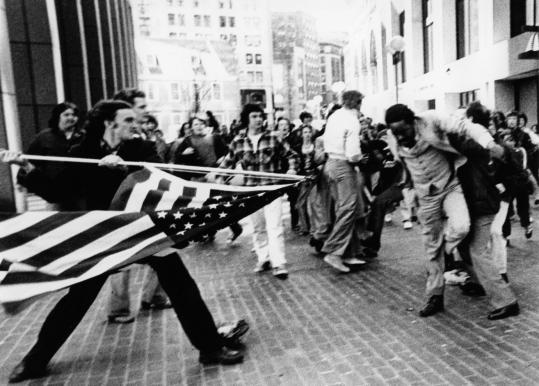
It may be the most infamous photo in Boston history, is certainly the most infamous of the post-1960s Civil Rights Movement, and still leaves a lousy mark on a city with a fraught racial history even if it also is a city that has also historically been a beacon for freedom and liberty, in both rhetoric and reality.
Ted Landsmark was an up-and-coming lawyer entering the political realm on April 5, 1976. He was running late for a meeting of the Boston Redevelopment Authority that he was set to chair. He had difficulty finding parking and was rushing to get to his meeting when he was set upon by white thugs, one brandishing an American flag, in front of City Hall. The moment marked the nadir of the city's busing crisis, indeed, a nadir in the city's history.
So it came as a surprise, I'm sure to many (it did to me) top read Landsmark's recent op-ed in which he called for an end to busing to try to achieve equalization in the racial composition of the schools in Boston. And yet his arguments are worth considering.
Busing is a more complex issue than either its opponents or its supporters are willing to acknowledge. When Swann v. Charlotte-Mecklenburg Board of Education allowed for busing to begin with it was deeply controversial, but not necessarily wrong. But once the court (wrongly, in my mind) decided in Milliken v. Bradley not to allow busing to cross city lines, and thus to give suburbanites the chance to opt out of the system, and to accelerate white flight, and to racialize the inner city, it meant that busing was virtually doomed to fail, at least in those cities that maintained limited geographic boundaries (unlike Charlotte, the home of the Swann decision ironically enough, which continued to expand so that the city and county lines became virtually indistinguishable) because it could not address the systemic geographic roots of so much segregation, especially in the North and particularly in cities and suburbs. The Milliken decision did not alone guarantee Boston's ugly mid-1970s fate, but it contributed. Today black Boston-area students who live in overwhelmingly black communities get up early in the morning to get on buses the majority of which will likely take them to schools that, wherever they are located, are likely to be made up of black and Hispanic students from elsewhere in the city. Ted Landsmark, the most visible victim of Boston's ugliest period, now opposes busing. His words are worth considering, but only after we understand the real reasons why busing failed.
Tuesday, January 20, 2009
President Barack Hussein Obama
Some early, perhaps scattered, thoughts:
Throughout today's monumental, historic, inspiring, and emotional events, my thoughts have continued to wander back to two individuals other, of course, than Barack Obama. I have written thousands of words about both and probably exhausted nearly as many hours thinking about them. One is Congressman John Lewis. The other, bizarrely, perhaps, is Robert Mugabe.
John Lewis is one of the central figures in Freedom's Main Line, and is someone who has earned almost universal respect for his courage and convictions. One of the central figures in the Civil Rights Movement during the 1960s, Lewis never fulfilled the role of charismatic leader. But charismatic leadership was always only a tiny slice of what the Movement was all about, the visible tip of an often obscured massive operation that may have required a Martin Luther King, Jr. for public consumption but that needed determined leaders like John Lewis to make things run. As a Congressman Lewis has similarly spoken out for justice and human rights, rarely (he is a Congressman -- to say "never" would be to protest too much) grandstanding, and always impressing with his strength of character and commitment. Seeing John Lewis in such a visible seat during the inauguration proceedings gave me joy on a day that all of us can celebrate, but that most of us have to recognize means that much more to African Americans. Barack Obama is our president, but to deny pride of place to African Americans would be churlish at best.
And yet as I listened to Obama present a speech that by his standards was merely adequate, but that instantly re-elevated the level of presidential speechmaking exponentially, I also thought about Africa and Africans. About Kenya, to be sure, and Obama's heritage, of course. But also about how someone like a Robert Mugabe has so abandoned his claim to speak for his people. About how Mugabe's ruthlessly thuggish kleptocracy has forsaken the people of Zimbabwe, has abused power, has made a mockery of democracy. About how perhaps a President Obama will be able to stare down Mugabe and his demonically clever machinations whereby all criticisms derive from the fiendish colonial past. Obama's earnest beliefs about both democracy and freedom place into stark reality the barrenness of Mugabe's claims to the country he so promisingly took control of nearly three decades ago. The Age of Obama should spell the end of the Age of Mugabe and his ilk. Not through Obama's force of will or use of force, but rather simply by his very presence. No longer should a Robert Mugabe be able to hide behind his people and stake a claim to Africanness that allows him to abuse other Africans.
As I am writing this, I am watching the Obamas walk down Pennsylvania Avenue and am listening to David Gergen speak of his fears about the first couple walking openly down the streets of Washington, fears I have shared (and repressed) all day. And yet as I listen I hear not fear or anxiety, but unfettered joy. More than that, I hear relief. The relief of generations. The relief of hope. The relief of possibilities unleashed.
The Washington, DC we all see and read about is the Washington of wing tips and power ties and constant jockeying for power and status anxiety raised to the level of sacrament. But the Washington that Washingtonians experience is the original Chocolate City, a black city. The shrieks of joy are also the shouts of a people. Michelle Obama received the slings and arrows of self-righteous outrage when she commented on her feeling pride in her country for the first time, an assertion as unobjectionable as her critics were ferociously obtuse. It would be facile to claim that we have overcome the country's tortured, demonstrable, long, shameful past, or to allow conservatives to seize upon Obama's inauguration as evidence that racism is a factor no more. But a specific era of racism, long dying, is dead. We are not at Dr. King's mountaintop. But on this, one of the truly great days in American history, its peaks are clearer than ever they have been. And that's something.
[Crossposted at the Foreign Policy Association's Africa Blog.]
Thursday, November 13, 2008
Race and the Election
Naturally many of the questions that have emerged after Barack Obama's historic victory in the 2008 presidential election have related to the question of race and racism. What does Obama's victory tell us about racism in the United States today? Since he won, is it not clear that we are free of the burdens or fears of racism in contemporary politics? Are we really in a post-race era in the United States? What role will race play in Obama's policies as president?
There is much to celebrate, and there can be no doubting that the United States has made tremendous strides since the Civil Rights Movement was in full swing. As veteran civil rights activist Charles McDew has often said, those who say things have not gotten any better were not there when things were bad. But improvement from a nadir is hardly sufficient to proclaim that we are past race. There is less racism in the United States than there once was. That hardly means that we are past racism. We just need to take a more nuanced perspective on the role that race plays in the United States, and we especially need to be aware that the black-white dynamic is no longer the sole, or even necessarily most important, dynamic when it comes to racial politics in the United States. Take a few minutes to listen to some of the more obnoxious statements from the anti-immigrant right and you might understand why it is not only black Americans who have a right to be skeptical that we have reached perfectibility on race relations in this country.
While race did not decide this election, that hardly means that race was not a factor in Obama's margin of victory, or that it did not play a role in specific states and localities or among particular demographic groups (including among those who supported him). But there is still much to celebrate, even if the rosiest pronouncements are pretty silly.
Race and racism will continue to have a place in the discussion. From concrete policies -- disproportionate sentencing, say, or affirmative action -- to those incidents, such as children blithely chanting "assassinate Obama" on a school bus in Idaho, we will have regular reminders that when it comes to racism, apologies to William Faulkner, the past is not necessarily past.
Sunday, June 01, 2008
Touring the Civil Rights Movement
In this week's Boston Globe travel section veteran civil rights activist Charles Cobb, who was a field secretary for the Student Nonviolent Coordinating Committee (SNCC) for much of the 1960s, provides a guided tourof tourist sites commemorating the Civil Rights movement in the South. This article seems to represent something of a reduction of Cobb's new book, On the Road to Freedom: A Guided Tour of the Civil Rights Trail.
Thursday, May 15, 2008
Loving Privately, Loving Publicly
Mildred Loving, the wife in the couple who brought the case of Loving v. Virginia, in which the Supreme Court struck down laws prohibiting interracial marriages, recently passed away. In an "Editorial Observer" piece in The New York Times, Brent Staples reminds us of the ways in which intimately private concerns became the foundation for a monumental court decision that the plaintiffs would have as soon never had to endure.
[Hat Tip to my top-notch student, Mary, for the link. For a review of the best history of interracial marriage in the United States in the post-World War II era I humbly direct you here, and to my getting the stamp of approval from Harvard University Press here. (If they can use me to further them, I'll gladly use them to further me!)]
Subscribe to:
Posts (Atom)

