Monday, February 09, 2009

Busing and Boston


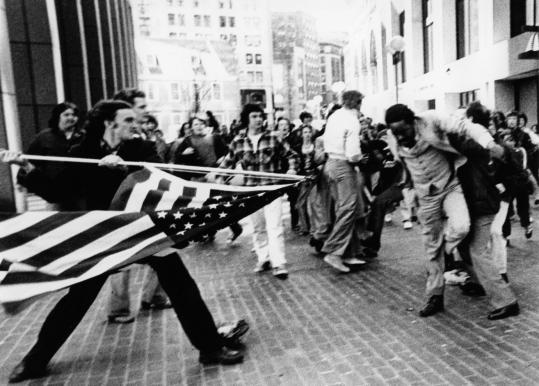
It may be the most infamous photo in Boston history, is certainly the most infamous of the post-1960s Civil Rights Movement, and still leaves a lousy mark on a city with a fraught racial history even if it also is a city that has also historically been a beacon for freedom and liberty, in both rhetoric and reality.


Ted Landsmark was an up-and-coming lawyer entering the political realm on April 5, 1976. He was running late for a meeting of the Boston Redevelopment Authority that he was set to chair. He had difficulty finding parking and was rushing to get to his meeting when he was set upon by white thugs, one brandishing an American flag, in front of City Hall. The moment marked the nadir of the city's busing crisis, indeed, a nadir in the city's history.


So it came as a surprise, I'm sure to many (it did to me) top read Landsmark's recent op-ed in which he called for an end to busing to try to achieve equalization in the racial composition of the schools in Boston. And yet his arguments are worth considering.


Busing is a more complex issue than either its opponents or its supporters are willing to acknowledge. When Swann v. Charlotte-Mecklenburg Board of Education allowed for busing to begin with it was deeply controversial, but not necessarily wrong. But once the court (wrongly, in my mind) decided in Milliken v. Bradley not to allow busing to cross city lines, and thus to give suburbanites the chance to opt out of the system, and to accelerate white flight, and to racialize the inner city, it meant that busing was virtually doomed to fail, at least in those cities that maintained limited geographic boundaries (unlike Charlotte, the home of the Swann decision ironically enough, which continued to expand so that the city and county lines became virtually indistinguishable) because it could not address the systemic geographic roots of so much segregation, especially in the North and particularly in cities and suburbs. The Milliken decision did not alone guarantee Boston's ugly mid-1970s fate, but it contributed. Today black Boston-area students who live in overwhelmingly black communities get up early in the morning to get on buses the majority of which will likely take them to schools that, wherever they are located, are likely to be made up of black and Hispanic students from elsewhere in the city. Ted Landsmark, the most visible victim of Boston's ugliest period, now opposes busing. His words are worth considering, but only after we understand the real reasons why busing failed.

Saturday, February 07, 2009

TPM Cafe Book Club

If you are looking for serious discussion about books, you could do worse than to bookmark the Talking Points Memo Cafe Book Club. Recent discussions have included Tony Badger, Alonzo Hamby, Andrew Bacevich, Nick Katzenbach, and many others.

Not to Say I Told You So . . .

I wrote the following as part of a post on Barry Bonds breaking Hank Aaron's home run record in 2007:
The chase is done, though the recriminations have just begun. The self-righteous await hopefully ARod taking the record away, because they who remained willfully blind suddenly have decided that ARod was never part of the scandal they never saw when it was happening yet see so clearly in outrage-fueled hindsight.

Well, now we have this.

Thursday, February 05, 2009

Flight of the Conchords Landing Near You

Normally, like any person with a modicum (even if only just) of dignity, I avoid novelty acts. But despite this general stance, I love Flight of the Conchords, the New Zealand folk duo that has stormed American hearts, largely through their brilliant eponymous HBO show. Bret and Jemaine are set to take flight (heh) on a nationwide tour.


Hat tip to the Thunderstick.

Encyclopedia Virginia (Incidental Self Indulgence Alert)

The Encyclopedia Virginia is now online. An effort of the incomparable Virginia Foundation for the Humanities (with which I was a fellow in 2004), the Encyclopedia is just one example of why the Foundation may well be the best state humanities organization of its kind. My modest contribution to the encyclopedia is an entry on the 1946 Supreme Court case Morgan v. Virginia, which directly led to the Journey of Reconciliation and Freedom Rides.

Tuesday, February 03, 2009

On Newspapers

I represent one of those dying cultural anachronisms. I still value, no, cherish, the newspaper. I read a number of newspapers online, and get the vast majority of the information I consume on the internet, to be sure. But I still value the daily newspaper, whether it is the Odessa American delivered to my door every morning, The New York Times delivered on Sunday, the San Antonio Express-News when we are down there, or the ritual of making sure to grab the local paper when I am traveling, unless it comes to the door of a hotel room, which is always a nice surprise.


I grew up reading my local paper and The Boston Globe that my stepfather picked up every day. Without descending into cliche, I love the tactile, tangible element of the daily paper, and I do believe that there are things you catch while reading through the newspaper that you do not when browsing the handy headlines and choosing what to click on when it arrives in your email inbox.


But we keep hearing that the newspaper is dead, and all signs certainly point that way. I hope something happens to salvage the print newspaper, but within a generation I would guess that the daily paper will be greatly diminished, if not an entirely defunct species. In the latest New Yorker, Harvard historian Jill Lepore (whose regular work there is fantastic) has an article on early American newspapers in which a subtext is that the medium's very survival was always in question. The goal may be to reassure, though the realities of this market are rather different from the colonial and early national era. It may not be entirely reassuring, but her piece will at least remind you of the resilience of the daily (or weekly) printed word.

Monday, February 02, 2009

The Somali Terrorism Connection

Are terrorists recruiting Somalians living in the United States? It appears so. And if so, for what purposes and to what ends? There is not enough here yet to draw firm conclusions, but there is enough to recognize that instability in the Horn of Africa has created ripe conditions for terrorist recruitment.

Friday, January 30, 2009

The First FML Review: Self Indulgence Alert

I received my first review (alas, already archived, so you'd have to pay for it) of Freedom's Main Line. The review appeared in the Chattanooga Free Press and is overwhelmingly positive, so I'm thrilled. The press will send out reviews and such once a month, so it would have been a real bummer to have to sit on a negative review for several weeks. here is the closing paragraph of the review:
Catsam, in compiling a fascinating history is not presenting solely black history or Southern history or civil rights history. he is presenting an ever-evolving American history, a concept underscored by the presentation of the book and reinforced by our recent election, which has presented us with a moment to look back and forward to the next stage of "Freedom's Main Line."

Yeah, I can live with that.

Not For Vegetarians: Friday Goodness Alert

Take loads of bacon and as much pork and what do you get, other than yummy awesomeness? A glorious new epicurial phenomenon known simply as The Bacon Explosion. Go. Make it now.

Thursday, January 29, 2009

RIP, John Updike, Baseball Fan

John Updike, a colossus in American letters by any measure, died Tuesday. He was 76. Updike was a baseball fan. And he contributed what is almost certainly the greatest single essay about the sport, an impressive accomplishment given the deep interconnections between baseball and writers. "Hub Fans Bid Kid Adieu" is a paean to Ted Williams, Fenway Park, and the game itself.


What a lousy week this has been for book lovers.

RIP Book World

The rumors are true. The Washington Post is abandoning the Sunday Book World as a stand-alone section and will be integrating it with other sections of the newspaper. This is terrible news for book lovers and especially for those of us who feel that serious writing about books is important.


When I lived in Washington, and whenever I travel there, which is fairly regularly, I have always looked forward to Book World as a staple. It always provided a non-New York centered look at books, and often was every bit as good as its New York Times counterpart, and on some Sundays could be significantly better. Much will be lost in this transition. And virtually nothing gained. I'm not quite in mourning. But I'm also not far from it.

Gladwell Takes a Beating

If you like a good old fashioned literary beatdown (and you know that you do) you'll thoroughly enjoy Isaac Chotiner's recent evisceration of Malcolm Gladwell's new book, Outliers that really serves as a repudiation of Gladwell's entire ouevre. I tend to enjoy, but not place a great deal of stock in, Gladwell's magazine articles, but have not yet read any of his books, two of which are sitting on my bedside shelf to be read at some future date. I have been uneasy about what I have read about the books, and Chotiner's review does not do much to soothe my wariness. But it sure is fun to read! Mean stuff so often is.

Misusing Quotation "Marks"

If you have ever graded student papers, or simply had to wade through a lot of bad writing, you've seen it: The profligate quotation mark. The single-most common comment I probably make on student papers is to circle unnecessary quotation marks and ask: "why"? This might become required reading for my students. (It will go along with this reminder, which I pointed out a few weeks ago, that the inapt quotation mark can also be used hamhandedly for ideological purposes.)

Saturday, January 24, 2009

Virginia Festival of the Book (Self Indulgence Alert)

I will be participating in this year's Virginia Festival of the Book on a panel called "Stories from the Civil Rights Movement." My panel is on Thursday, March 19th, at noon at the UVA Bookstore. It probably goes without saying that I'll be promoting Freedom's Main Line. But I'll say it anyway. (And yeah, that's the worst picture ever.)

A Difference of Opinion on Oscar

My goodness, how's this for diametrically opposed views on the just-announced Oscar Nominations?: They either mark the triumph of quality or a tremendous disappointment that reflected a bad movie year. Because of the late-year timing of virtually all of the best picture nominees, and their even later arrival here in West Texas, this is the first year I can ever remember when I have not seen a single best picture nominee by nomination announcement time.

A Little Tearjerker

If you are an animal lover the fact that you know what's coming will in no way soften the blow when you read this Sportsguy story about "Dooze," his beloved family dog.

Friday, January 23, 2009

At the FPA Africa Blog (Self Indulgence Alert)

Just a quick note to direct you toward the Foreign Policy Association's Africa Blog where I have been busy covering a whole host of events ranging from Somalia to Guinea to the Democratic Republic of the Congo and beyond, and of course lots of coverage of the Zimbabwe crisis and South African politics. Please check it out.

Baseball 'Round the Corner

On Valentine's Day pitchers and catchers can report for spring training. Thus the countdown can begin soon. Now is as good a time as ever to point out that the American League East race is going to be epic in 2009.

The Best of Rickey Being Rickey

In honor of Rickey Henderson's induction into the Hall of Fame, here is an amusing ranking, from a few years back, of the Top 25 Rickey Henderson moments. Suffice it to say I'm looking forward to that speech in the summer.


Hat Tip to my buddy Bill.

Thursday, January 22, 2009

Claiming Credit While Not Taking Blame

The Bush administration and its advocates like to point out the lack of any terrorist attacks on American soil after 9/11 as evidence of a crowning success in President Bush's Global War on Terrorism. Former Bush speechwriter Marc Thiessen argues as much in today's Washington Post. The argument is fine as far as it goes. In the wake of 9/11 many observers -- myself included -- expected other attacks to follow. They did not. Whether this is the result of Bush policies or an inability of al Qaeda (or anyone else) to follow up on their massive undertaking on that awful September morning is up for debate. But it is true that no attacks followed the terrorism of 9/11.


However, it seems rather shortsighted to simply look at that fact and claim it as a major accomplishment. After all, the Clinton administration went even longer without an attack on US soil from foreign terrorist groups after the first World Trade Center bombing in 1993. Furthermore, how is it possible to take credit for a lack of attacks after 9/11 without at the same time acknowledging that the administration did not stop the worst terrorist attack in American history? Bush's advocates cannot possibly have it both ways, denying any responsibility whatsoever for not preventing 9/11 but claiming a lack of attacks after 9/11 as the result of successful policy. 9/11 happened during the Bush presidency. That is an immutable fact. The failures on 9/11 were systemic, to be sure, and blaming Bush, or blaming Clinton, would be largely pointless. Until you start using the lack of attacks as a political chit. At which point, the rules of the game change.


Finally, the United States has allies. In part as a nearly direct result of their coordination with American policies, Spain and England suffered terrorist attacks after 9/11. (I was in England on the 7th of July, 2005.) Shallow triumphalism on terrorism needs to take into account that the Global War on terror (Bush's titular creation, not mine) was, well, global. To declaim an attack in London or Madrid because it does not fit the narrative qualifies as rank opportunism (and pretty crass abandonment of the significance of our allies). It hardly meets the standard of rigorous political analysis.