Thursday, July 24, 2008

Safundi and Southern Identity: Self Indulgence Alert

Jeff Woods, a grad school colleague and friend, and I are the guest editors for a special issue of Safundi: The Journal of South African and American Studies devoted to the theme of Southern Identity. In addition to editing duties, I contributed the introduction and the conclusion/response to two prominent scholars who wrote responses to the issue. we are proud of the final product.


We came up with the idea at the Southern Historical Association's annual meeting in 2003, put forward a call for papers in January 2004 and have been working on the project in fits and starts ever since. originally conceived as a book project, in the end, doing it as a journal issue made more sense and worked out well for us. If you are in academia and your library does not subscribe to Safundi, make an inquiry, request it, lie and say that it is essential to your work. If you are an individual, subscribe. It is well worth it.


I have taken the liberty of placing a link to this issue under our slowly expanding list of books and similar publications.

Oldy McOlderson Speaks

From this week's Sports Illustrated (Print edition -- no link) "They said it," Bill Webber, the oldest living former Major League player at 100 years old commented on today's players:
"The hair's too long. Their beards are too evident. They're a grubby looking bunch of caterwaulers."

Greatest. Quotation. Ever.

Wednesday, July 23, 2008

Training Camp Kicks Off in Foxboro

Although I am excited for both college and pro football in the abstract, I am not really ready for the reality of the Patriots starting up again. Given that they were the best sports team I have ever seen for 18 games last year and given how the season ended, the hangover has had a dampening effect on my spirits. The Pats climbed to such heights last year only to fall short at the end that it is almost unimaginable where they can go this year. Part of me thinks that they are likely to go 13-3 and win the Super Bowl with less history on the line and consequently less hype. Part of me worries that they will get old all at once as happens in the NFL.


But taking the emotional investment out of the equation, it is hard to imagine the Patriots not being one of the best teams in the NFL this season. They won't slice through the league like they did last season, and there will almost certainly be no run toward an undefeated season, but they should still be playing in January. Training camp, which starts in a few hours in Foxboro, will be a bit tough to endure because there will be a lot of reflection on what almost was, but once the games get started all wil be fine again. Christopher Gasper of The Boston Globe has ten storylines to watch develop as training camp kicks into gear.

Come Fill Your Glasses Up!

Williams has a new head track and field coach. My old head coach, Pete Farwell, who some time ago stepped down from head track coaching duties to focus on his championship cross country teams and coaching the distance runners on the track team, took the program over again this year after some controversy caused his successor to step down. After a national search, one-time Williams assistant coach Fletcher Brooks has been hired to take over the program. A former All American shot putter and football letterman at Allegheny College, Fletcher is also the brother of my friend and former teammate Ethan Brooks, who had a nice career in the NFL, including a couple of years as a starter for the Baltimore Ravens. Fletcher will be leaving MIT, where he has been head coach of the women's team and has worked with the men and women throwers.


I have no doubt that Fletcher Brooks will lead the Ephs to more glory in the years to come. As an alumnus not only of the school, but also of the program, I have high expectations for him to have a long and successful tenure at the head of the Williams College track and field program. All he has to do every year is beat Amherst, win Little Three, ECAC, and DIII New Englands and contest at the All New England meet, produce All Americans, and make noise nationally. Basically, all of the things that Williams track has been accomplishing just about every year since 1990 or so.


[Gratuitous and self indulgent shot of the winning long jump at the 1993 Williams Relays.]


Go Ephs!

Hometown Media

It has not been a great few days for the print media in my home town and its environs.My dad told me the other day that the weekly paper that covers local news, the Argus Champion, is closing its doors. It is hard to explain what the Argus means in a town like Newport. There is a daily newspaper, the Eagle Times, based in the (larger) town next door, Claremont. But the weekly newspaper always held the soul of newport. Or it did until a few years ago, when the coverage started leaning toward some of the more affluent nearby towns. For many in Newport, this is the real reason why the Argus failed.


In high school the Argus was especially good at covering local sports. Each week the paper chose an athlete of the week, and a local grocer sponsored the award by giving the winner two free steaks. I must have had two dozen steaks as a result of this partnership, the sort of thing that characterizes, indeed defines, small towns. The Eagle Times does a fine job of covering high school sports, but its coverage area is such that it encompasses well more than a dozen small communities and their high schools. The Argus was for our town and our teams, with a strong emphasis on Newport Tiger sports. I so rarely get home, and must admit that I do not go online to look at the Argus at all often. But like every other institution in my hometown, just knowing it was there has always been comforting.


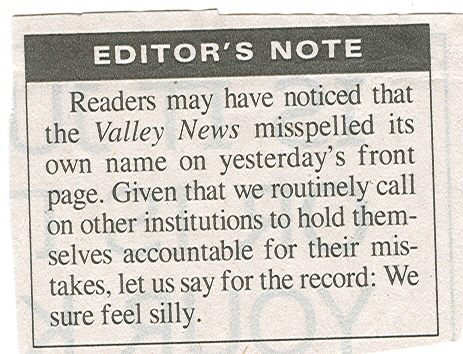
On a lighter note, yet another basically local paper, the Valley News, which was based a few towns away and thus rarely figured in our day-to-day lives (unless we accomplished something against one of the Upper Valley teams in sports) has made news lately for a rather embarrassing snafu. On July 21, the newspaper misspelled its own name. On the front page:
The paper later sheepishly apologized:


[Hat tip to Patrick Appel, one of the writers still subbing in for Andrew Sullivan, for the Valley News gaffe.]

Wistful for The Wire

So I go to look at my Tivo (or whatever mine is called -- Tivo has become the Kleenex of digital tv recorders) list last night, and my reaction was almost wistful to seeing an episode of The Wire, the greatest television show ever, newly minted on the newly recorded programs. Apparently HBO is re-airing one of the old seasons, perhaps the first. I have a tirade built up about the fact that The Wire got snubbed again by Emmy voters, forever confirming in my mind that Emmy's are useless and indicative of nothing, certainly not the best that television has to offer, but I just do not have the energy or time. trust me that the bile is there, though. Recently The Guardian's Sam Delaney interviewed Dominic West, who played drunken, womanizing, profanity-spewing (God Bless him every one) Jimmy McNulty.


The Thunderstick has been pestering me to start watching Lost on dvd, and I finally got season one, but I'm not going to kid you -- I'm feeling a huge magnetized force pulling me toward Baltimore's mean streets. Fortunately I hear great things about Generation Kill, the latest project from the guys who brought us The Wire, and I'm Tivoing that as well, so perhaps David Simon & Co.'s take on Iraq will substitute for my desire to get back in the game of Bodymore, Murderland.

Food Service Memories

If you have ever worked in a restaurant, you have horror stories. Rude customers (let's just give them numbers one through five on this list), imperious prima donna bosses, the revelation that food can be pretty gross, and, if you've worked in the kitchen (which is my background) you know just how much manual labor is involved when it is your shift to wash the dishes. And then there is the heat, good God, the heat.


Despite all of the complaints, I owe a debt of gratitude to the time I spent in the kitchen at the Backside Inn in Goshen, New Hampshire. (Goshen represent!) While there I learned how to cook. I spent one summer doing nothing but baking and making salads, and that gave me a solid foundation and passion for cooking that never subsided. And that summer I got out of the nighttime kitchen drudgework. I was the equivalent of a white-collar worker that last summer.


Memories of that time came back to me when I read this interview in The Boston Globe with someone known only as "The Waiter," who is the keeper of Waiter Rant, a blog based on his table-jackeying in New York City. He is also the author of a new book, Waiter Rant: Thanks For the Tip -- Confessions of a Cynical Waiter. I'm sure most of you have done your time in the food service industry. This may either bring back deeply repressed memories or stir that bittersweet blend of nostalgia and revulsion that so many incidents from our past do.

Tuesday, July 22, 2008

Zim's Talks

Over at the FPA Africa Blog I have my analysis of the Zimbabwe "talks about talks" that has led to an agreement between Robert Mugabe/ZANU-PF to meet with Morgan Tsvangirai/MDC to try to settle the crises there. Let's just say that I am not especially optimistic, even if I am hopeful.

Kolmanskop

The blog Oddee has a feature (with lots of great pictures) on the ten most amazing ghost towns in the world. I have only been to one of these, but it is the one ranked at the top of the list, Kolmanskop in Namibia. It is every bit as spectacular as the pictures indicate, as is the entire Skeleton Coast of Namibia.


Hat tip to Patrick Appel, one of Andrew Sullivan's pinch hitters while the doyen of blogging is taking a break.

Monday, July 21, 2008

The New England Revolution: Is There Anything They Can't Do (Other, I Mean, Than Win an MLS Title)?

In a pre-9/11 world the story of members of the New England Revolution subduing a clearly deranged streaker on a cross-country flight would fall into the category of amusing stories that bloggers use to fill out their content (guilty!). Although the story is absurd, it is also easy to imagine why "Some passengers became frantic during the incident." And even if you are a passenger who did not become frantic, and even if you are no pollyanna, a closed space with childrfen is probably not the time you are going to chuckle about a streaker. A lot of guys I know, myself included, would have jacked the guy in the face the first time the guy popped out of the bathroom in the altogether. Nonetheless I look forward to seeing how Homeland Security and the FAA overreact to this event and come up with utterly irrelevant and improper responses, a la the arbitrary and absurd 3 oz. bottles-in-ziplocks solution to a non-problem.

Friday, July 18, 2008

Happy Birthday Madiba!

Today marks Nelson Rolihlahla Mandela's 90th birthday. The great man is slowed but still robust, with his characteristic grace and wit still intact. As South Africa muddles through, the country's leaders would do well to dwell on Mandela and his meaning, not merely his undeniable symbolic power, and not even the mythology that surrounds him -- in some cases rightfully -- but rather on his approach to leadership and governing.


Mandela's greatness stems not from his perfection -- he was not perfect and would be the first to recognize as much -- but rather from the humility of his approach, on his willingness to compromise, on his loyalty, and on his unparallelled integrity. As just one example of a shortcoming leading to positive action, Mandela recognized even before he had left office that he had fallen short on what would prove to be one of the country's, the region's, biggest challenges, the threat of HIV-AIDS. And so his foundation has tackled that issue head-on and in so doing has done much good on that scourge that so haunts the country.


Mandela emerged from 27 years on imprisonment by a regime that deserved no quarter. But Mandela knew that in order to accomplish his goals of a non-racial, or multi-racial South Africa with one-person, one-vote democracy, he would have to negotiate with his enemies. And so he went about establishing the conditions for negotiation, cajoling some of his more skeptical comrades while at the same time making clear to the National Party the parameters within which negotiations would happen. Mandela was not the sole, perhaps was not even the most important, negotiator for the African National Congress, but he was the most important figure in the negotiation process, and knowing this, Mandela leveraged his identity and his leadership to bring about the end result that he desired.


Nelson Mandela will not live forever, yet he will live on. the question is how he will live on: As the father of a new South Africa forged in the consensus of the Freedom Charter or as the lamented apogee of an ANC gone awry. It is too facile to speak of historical crossroads, and yet South Africa certainly seems to be dealing roughly with the post-Mandela era. Thabo Mbeki will likely leave office scorned, his absence not long lamented despite his own well-earned status as an ANC exile leader. Jacob Zuma is hardly off to a promising start as the president of the ANC, and though it appears that he and his supporters may well find a way to cause the corruption charges against him to evaporate, as the country's president Zuma seems detined to be a divider rather than a uniter. South Africa does not need another Mandela -- there can be no such thing and we've been lucky to have the one -- but what it needs is leaders who look beyond Mandela's symbolism, beyond the birthday praise, however insufficient in relation to what the man accomplished and has meant to so many, and who can capture the essence of what Mandela wanted for his country and his world.


Grown men are not supposed to have heroes, or in any case are not supposed to worship them publicly. But Mandela is my hero. And he is the hero of millions. Long may he live in the minds and hearts and actions of South Africans and people the world over. More important, long may he live.


[Crossposted at the FPA South Africa Blog and the FPA Africa Blog]

Back to SA!

Naturally after a month out of the country, while still dealing with jet lag (I never4 get jetlag coming east to west except that this time with the layover in Dakar I got in at 6 in the morning in the States) two days later it seemed like a good idea to drive down to San Antonio for the weekend. The drive went smoothly yesterday, but I was out by 9:30 last night, something that happens about twice a year as I'm normall;y a very late-night person. I'll be here for the next few days and will post as I can.

Wednesday, July 16, 2008

Back in the USA!

40+ hours, one lost piece of luggage, three movies, several television shows, two read books, several newspapers, and virtually no sleep later, I arrived back home last night. I am catching up on life and will resume posting soon.


[Crossposted at the FPA Africa Blog and the FPA South Africa Blog.]

Monday, July 14, 2008

Departure Day

After three weeks here in South Africa, this evening I will board a South African Airways plane bound for Washington, DC’s Dulles International Airport via Dakar, Senegal. If all goes well I will land at 6:00 am eastern time tomorrow, Tuesday, at which point I’ll hope that I can get to BWI in time to catch my onward flight that will eventually take me back to Texas.


Leaving South Africa is always bittersweet for me. I love this country, its people, its culture and politics and sport and even, in odd ways, its history. And every time I leave I have no real idea when I will next be back. Next year? 2010? As of right now, I am simply not sure. South Africa is a part of my life, a vital part, and when I leave I will miss it even as I am excited to be home again, to see my wife and friends, to sleep in my own bed, and not to live out of a bag.


Over the course of the next few days I will continue my assessments about what i have seen and done in the hopes that it will continue to shed light on how I see South Africa right now, in the middle of 2008. Between now and then I have much traveling to do with a very cranky back. in the airport I am set to see a Zimbabwean friend who has fallen on difficult times here in South Africa. And then I’ll leave South Africa again, knowing full well that I will return, soon if not soon enough, to this place I have so come to love over the last decade-plus.


[Crossposted at the FPA South Africa Blog and the FPA Africa Blog.]

Sunday, July 13, 2008

South African Politics

I have written some of my observations about South African politics at the Foreign Policy Association's South Africa Blog and Africa Blog. Please do check one of them out if you get a chance.

Saturday, July 12, 2008

Back in Contact

My apologies for the silence here for the last week or so. Traveling in South Africa sometimes means not having the sort of internet access or opportunity to write as I might like. The last few days have taken me from Cape Town to Grahamstown and Rhodes University, one of my old homes. From there I came up to Johanneburg where my South African adventure will end without the hoped-for Zimbabwe trip for reasons simultaneously byzantine and prosaic.


In the next 48 hours before I leave for my return flight to the US I shall make some observations about a number of facets of South African life as it is in 2008.


Cross-posted at the FPA's South Africa Blog and Africa Blog.

Friday, July 04, 2008

Happy 4th of July (And the Meaning of America)

To my readers in the United States: Happy 4th of July!

To my readers in South Africa and anywhere else on the globe: Happy Friday!

In the last dozen years I believe I have spent more American Independence Day holidays outside of the United States than within it, with most of those spent here in South Africa. Being abroad usually provides an interesting perspective on one's own country. I consider myself to be patriotic in the most important and perhaps least jingoistic sense in that I love my country but I see its flaws. I honestly have no idea what people mean when they say that the United States is the "best country in the world." I guess I do not dispute the assertion at its essence, but I have no idea what "best" means, and why those who make the assertion do as much with such totality. The best at what? The best by what measurement? Is patriotism simply the willingness to rank arbitrarily one's country by some sort of flow chart or Olympic medal chart? I will grant that the United States is the most powerful nation on earth militarily, politically, economically, and culturally. And as a result I think it can be argued, and I would, that the United States is the most important nation on earth. But nation-states not being reducable to one's favorite sports team or top-five pop bands, I see neither utility nor meaning in the "best country in the world" mania that strikes my most jingoistic countrymen and women.

At the same time, it is always telling to see what others think of one's own country. I have found the supposed anti-Americanism that is supposedly pervading the world to be vastky overstated. I am certain there are places where that sentiment is strong, such as in much of the Middle East and in certain quarters in Europe, say. But on the whole what I find, especially once I convince the listener that I am not an agent of my state and that I do not represent American policy (even if I may defend elements of it or the larger framework within which that policy operates) I will have engaging, if occasionally lively, conversations.

The fiasco in Iraq has not done the US any favors abroad, nor has the arrogance our current administration has put forth in presenting the American face to the world. But at the same time most people in South Africa and elsewhere understand that our administrations are temporal where the American state is not. And so what I hear most often are questions about the current campaign for the presidency, and whether Obama can win, and if McCain is a Bush clone.

It is my experience that the rest of the world is very much interested in the United States and its role in world affairs and looks at America with a combination of awe and fear and respect and admiration and concern and envy. This may be impossible to quantify, but it is a lot more interesting, and telling, than simple assertions that America is "hated" or loved.

[Crossposted at the FPA Africa Blog and the FPA South Africa Blog.]

Thursday, July 03, 2008

The Reasons I Travel

At the end of the day, travel is, for me, about people. Whether I am returning to Africa or to the UK, places I visit regularly, where I have lived and worked, or whether visiting someplace for the first time, such as when I went to China a couple of years back, the most important component to me is always the people I meet, and friends new and old. This is not to say that there are not other factors -- work, for example, certainly requires me to travel quite regularly, and provides the justification for these trips. And like anyone who leaves home a lot, I like experiences as well, whether cultural, aesthetic, adventure, or what have you.

But the most important element of travel is people. I am staying in Sea Point, in Cape Town, with my good friend Doug, a black Zimbabwean who has lived in South Africa for more than a decade. We met in 1997 when we were at Rhodes University, in Grahamstown, and he is one of the people I always try to meet up with when I return. The time here will be too brief, but it is important, indeed crucial, that I spend it here. The conference in Stellenbosch provides another example. I walked into the conference venue knowing of a handful of the people there but actually knowing only one, a grad student at The University of Texas who I nonetheless always seem to see in South Africa. By the time I left Stellenbosch yesterday I had made a handful of new friends, some of whom I'll maintain contact with professionally, a few of whom I will likely remain friends with over the years.

In some ways I think I'be grown almost sanguine about the opportunities travel affords me. I brought my camera on this trip, have been able to see some new places and revisit old ones, and have yet to snap a single shot, which probably seems like a waste, but in my eyes just remonds me of all of the time I have spent here and the ways in which I try to immerse myself.

In any case, Cape Town is raw this morning -- rainy and damp, cold -- and I have decided to devote a day to trying to catch up on work. I apologize for the fundamentally personal nature of this entry, which lacks much insight into South African politics or history or culture. But South Africa is, for me, more than simply a tableau for politics and work. It is a real flesh and blood place where I've spent a large proportion of my life and energies for nearly a dozen years. So today I'll just work for a few more hours until Doug, my friend, gets home from work, and we'll go out to eat and for a few drinks before tomorrow, when all too quickly, I'll be leaving again.

[Crossposted at the FPA South Africa Blog and the FPA Africa Blog.]

Friday, June 27, 2008

The Banality of Travel

Up at 4:00 am. Midland-Odessa to Houston. Sprint to catch my plane since we were delayed on the ground in Midland. Worry about luggage transferring. Houston to Jackson. Chill on plane. Jackson to BWI. Late by more than half an hour. Luggage takes forever to come out, which has me nervous as I have two hours to get to Dulles, which is where I'm leaving from for South Africa. (Dumb booking, don't ask.) Let Super Shuttle clerk convince me that the normal $74 shuttle may not get me there in time because of multiple stops so I should book the $128 solo trip, which she promises will arrive to fetch me in ten minutes. I'm convinced if wary. Catch shuttle. (Seventeen minutes later.) Get to Dulles with more than enough time to spare. Wonder if I'd have been ok with regular shuttle. Wonder if concerned shuttle clerk gets kickback. Wonder if it makes me a prick not to tip the guy more than the $2 that I do given the cost of the trip and the fact that I otherwise only had twenties.


Smooth sailing with South African Airways. Until we board. There is some failure in electric system. Delay. Temps rise. It must be 100 degrees in the cabin. At least there are only two of us in the four-seat middle row. Chat with seatmate, a South African with whom I share some interests. Flyflyfly. watch movies and tv shows and read and eat and have wine. Land in Dakar, where I've never been. Yeay! Do not get to leave plane. Boo! More electric failures. It must be 125 degrees in cabin. Go to door of plane, which is open and where we are allowed to look out on the forbidden land. Dakar is remarkably cool outside at 6 in the morning. Airport seems a bit isolated, except the to my mind nightmare security risk of a settlement of some sort that appears to be separated from the airstrip by, well, nothing. Bet with seatmate as to whether someone will join us. I assume worst: Yes, and they'll be fat. I happily lose bet. Late departure. Nearly two hours behind. I hope the person picking me up at airport from my guest lodge sticks around. I wonder if I would. Flyflyfly. Try to sleep in awkward positions. Flyflyfly. Note to self: Ordering the eggs for breakfast on a plane was a bad idea. Don't do that again.


Arrival -- 90 minutes+ late. Passport control. Stand in line. (An hour passes.) Passport control: Still standing in line. New security guy comes, tells us all to move to another line if we are not South African citizens. His predecessor had moved us all over to this line. I'm next to go. Pretend I don't hear. Rehearse nakedly dishonest answer in Afrikaans. Person in front of me hits snag at counter. Security guy behind me. Passport control lady calls me forward. Phew! Luggage waiting for me. Phew! Guy from B&B waiting for me. Phew! Drive to Melville. Get into guesthouse.


Go out. Eat lots of seafood. have some beer. Get back to guesthouse -- much easier to do than woman who runs place made it seem to be. Supposedly challenging secret stairway shortcut not daunting for people capable of walking straight down or up a hill of stairs and ignoring smell of urine. I can do both. Cannot figure out tv. Figure out tv. Crash. Wake up annoyingly early. Eat.


You're basically caught up. Travel carries with it its share of banalities.


For my actual substantive observations of my first twelve hours or so in South Africa go see my extensive post over at the Foreign Policy Association's South Africa Blog or Africa Blog. That's where I'll chronicle most of the trip. Time to brave those stairs . . .

Tuesday, June 24, 2008

Slice is a Babydaddy!

Our boy Homz is now a proud big papi. Congrats, big guy. I'm so happy for you all.

WTF?

A.N.C. Rejects Outside Pressure on Zimbabwe

Southern Africa Bound

Tomorrow at the ungodly hour of 5:00 am I begin a three-week trip to southern Africa. The main foci of the trip will be two conferences. One is on South African sports history at the University of Stellenbosch, where I'll be presenting a paper on rugby, race and nationalism in South Africa since the 1995 Eorld Cup, and the Historical Association of South Africa biennial meeting, which I usually try to attand, where I'll give a paper about white supremacy and black resistance in the US and South Africa in the 1940s. The latter conference is at my old home, Rhodes University, and the paper is basically a sectiopn from the introduction from my next book. I also will be conducting research and doing some leisure travel where I can squeeze it in.


But my other goal, and we'll have to see if it is even feasible, is to go to Zimbabwe for a few days to see firsthand the situation there. I have been writing extensively about Zimbabwe lately, and have another op-ed coming out in the Cape Argus tomorrow (in which I manage to invoke the Freedom Rides in a historical analogy. Synergy!) which hopefully won't register with the good folks north of the Limpopo. Zim isn't especially friendly to those practicing journalism without a license, and while I am not a professional journalist, something tells me that such an argument might represent a distinction without a difference in the minds of ZANU-PF thugs. Nonetheless, I want to see what is going on in Zim, and I assume that I am both small beer and that the border control folks do not routinely access Google or read the Cape Argus and remember its contents. Besides, how bad can a Zimbabwean jail be?


The main point is that I'll be away, posting here may be light, most of my on-site reportage will go on the FPA blogs, and I hope to publish some longer pieces either while I'm there or after I get back. Nonetheless I'll update as I can.

Talking With the Enemy

The debate over whether to talk to dictators is hopelessly silly. Of course we always have, of course we always will, and almost certainly we should. in another political climate this would be a nonissue. This is, alas, not another political climate.

Monday, June 23, 2008

Technology's Burdens

Rob Horning at Popmatters has an insightful post on consumerism and the false allure of free stuff that more than anything speaks to me about the tyranny of technology that supposedly makes our life better by giving us more access to free information at our fingertips. And for those of us who work in the realm of knowledge and information there is nothing more seductive than free information.


And yet at least for me, this access is at best a dual-edged sword. I get probably a score of news sources sent to my main email account regularly. Most of this I can justify as work, at least broadly, inasmuch as so much of it helps me stay abreast of African developments that are crucial to my writing on the Foreign Policy Association blogs and elsewhere. But couple these with far too many listservs, and then with a slew of personal email or email from actual people related to professional stuff, and then emails that qualify as junk, and then emails that qualify as semi-welcome junk (emails I signed up for that nonetheless is geared toward selling me something), and then emails regarding financial stuff -- credit card statements, cell phone, etc. and you begin to see the problem. On a day when I'm diligent about emails I find that I'll stay on top of that day's inbox -- unless something big happens in Africa, say -- and may whittle away at ten emails from, more than likely, yesterday, before other duties intercede. then to top that off with the fact that my account was violated some time ago, and I am still dealing with the ramifications (oh yes -- whoever got in there not only copied my contact list but stole it. If we know one another I probably don't have your email address any longer).


And so it was with equal parts fear and loathing that I loaded my main and campus email accounts on to my new Blackberry today. The deluge is already coming. And I asked for it.


(Via Andrew Sullivan, who picked it up from Nicholas Carr

Sunday, June 22, 2008

McCain's Energy Follies

In recent weeks John McCain has been misrepresenting and obfuscating both his and Barack Obama's record and views on energy policy. Newsweek and Factcheck.org are on the case.

Saturday, June 21, 2008

Hooray Tom!

You should all take time to read Tom's latest article, A Troubled Past: The Army and Security on the Mexican Border, 1915-1917, which just came out in the Military Review.

Schilling and the Hall of Fame

Is Curt Schilling a Hall of Famer? That's the question Nick Cafardo addresses in today's Boston Globe. Schilling, as you may know, is undergoing surgery and is out for the year and may be done for good. He earned his place in Boston lore with his legendary postseason performances in leading the Sox to two World Series titles. The question is, will that be enough to garner him entry into Cooperstown?


Schilling is a classic borderline Hall of Famer. His overall numbers are good but not spectacular. For better or for worse, pitchers are assessed by a statistic that is rarely indicative of the pitcher's performance alone, wins. If Schilling's career is over, he'll finish with 216 wins. Impressive, but far from extraordinary, especially for the rarefied air of the Hall of Fame. Most of his stats fall into that slot. And yet those postseason numbers. 11-2 in 19 starts with a 2.23 ERA and four complete games. A World Series co-MVP with Randy Johnson. And of course the two championships with the Sox, including the iconic bloody sock game against the Yankees.


My heart says yes. My head says let's wait five years and see how we feel then. Either way, though, if this is the end, as a Red Sox fan all I can say is "thanks." Curt Schilling has been the ultimate gamer over the course of his career, and as an elder statesman with the Sox he took young pitchers under his wing. The Cooperstown worries can wait. For now, let's hope Schilling gets a ring and a World series winner's share for 2008.

Friday, June 20, 2008

Cracking the Granite State

At The Washington Post EJ Dionne shows how close the presidential contest is likely to be in New Hampshire, and how in a close election the Granite State and other small states might play the role of kingmaker. When I was growing up in the land of John Sununu the idea that rock ribbed republican New Hampshire could be in play for Democrats would have been absurd. And yet given demographic and political changes in the state (which I have always argued was less conservative than libertarian) in recent years and the state's recent trends, I do not quite grasp why Dionne seems to surprised by these changes, especially given that nosedive this administration has taken in popularity and reputation since 2004.

The C's Top Ten?

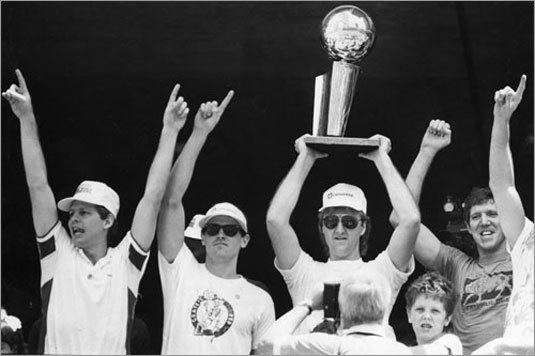
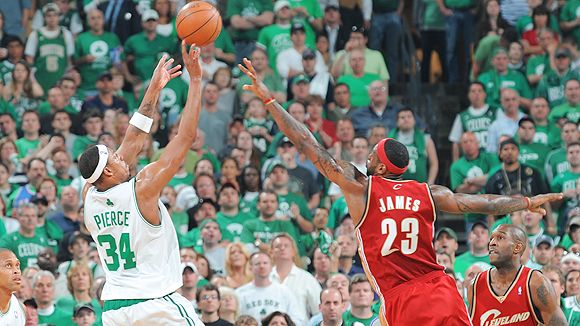
In an early effort to place the Celtics' recent title in historical perspective, Bob Ryan ranks his Top Ten Celtics teams of all time. Not surprisingly, the 1985-1986 team tops his list. Surprisingly this year's team gets number two. But most shocking to me is that of his top ten, three did not win the championship, and one did not even make the finals. Bob Ryan may be the most respected basketball writer in history, so I will tread lightly with my criticism, but it seems a dubious decision to argue that the team that has the most NBA titles has three teams that were better than ten championship teams. I am firmly of the belief that "better" being subjective, winning it all is a better sign of greatness than whatever we project onto teams that did not win it all. Still, the whole excercise is thought provoking, serves as a reminder of the storied history of the C's, and is fully worth it if only for this picture:

Wednesday, June 18, 2008

Celtic Pride: Or, The Wearing of the Grin


I have been remarkably silent about the Celtics over the last few weeks.


Don't mistake this for anything other than what it is: I'm superstitious as all hell.


Curses are dumb. They are not real. But I'll be damned if I am going to be the one who messes with fate.


And so for two months I've been wearing the same C's hat. I've been drinking the same Sam Adams beer during games. And given how the Patriots performed in the Super Bowl I've been uncharacteristically humble about the guys in green. Given that I'm a Red Sox fan who well remembers life before October 2004, I've been fatalistic. Given that it has been more than half of my life since the C's were the most dominant team in the history of American professional sports, I've been intolerably uptight. In sum, I've been miserable (albeit with good beer and a comfortable hat at my disposal). If I have learned anything, I have learned that there is no commutative property of sports. That the Red Sox and Patriots have been successful has had almost no bearing on my emotional reaction to the Celtics of late.


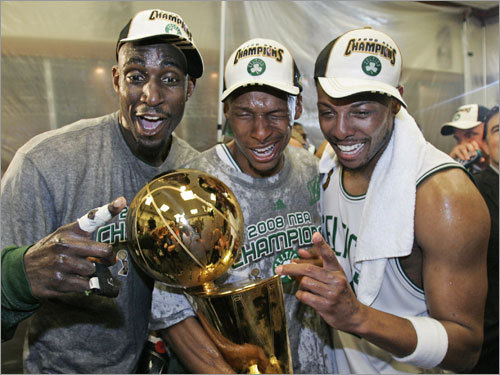
Odds are that if you are reading now, you know exactly what happened in the game last night. The Celtics crushed the Lakers. Humiliated them. The C's suffocated the Lakers when the visitors were on offense (enough of the Kobe as Jordan comparisons, eh?) and buried them when the C's were on O. The Big Three proved to be stars, the supporting cast overwhelmed, and the bench made all the difference, outplaying the much more heralded Lakers Bench Mob for the entire series. It was quite clear from early on that the better team came to play, and while the team from Hollywood had come in hopes of something magic (or Magic) happening, instead Red reached on down and ... .


If you are a Celtics fan a breathless recap will be thrilling to you. But there are better places to get that. (See Bob Ryan's article here, Dan Shaughnessy's here, Sportsguy's here and if you are into schadenfreude -- and you know you are -- I'd strongly recommend the columns by the LA Times' Bill Plaschke, TJ Simers, and Mark Heisler.) And if you are not a Celtics fan this is just annoying -- more Boston sports crap in an era where Boston sports crap seems to be ubiquitous. (Nota bene: Don't blame us. Root for better teams.)


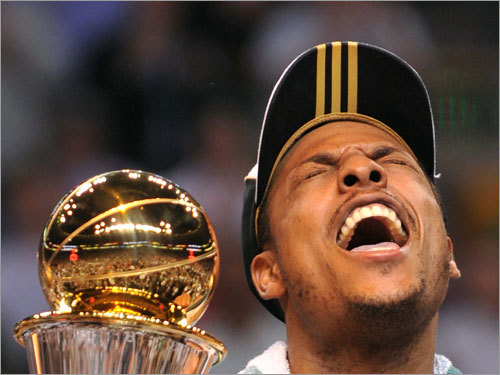
I am happy as a lifelong Celtics fan. I am happy as a longtime Paul Pierce booster.

I am happy as a guy who was lucky enough to be born into a legacy that included Bill Russell and Red and Cousy and Havlicek and Tommy and Jo Jo and the Jones boys and Luscy and Cowens. I am happy as a guy who grew up with Larry and the Chief and McHale, but also DJ and Cornbread and Henderson and Walton. I am happy as a guy who lived through the deaths of Len Bias and Reggie Lewis. I am happy as a guy who saw a generation of basketball fans grow up worshipping Jordan and anointing Kobe because they did not know what came before them. I am happy as a fan. Title number 17, against the Lakers, at the New Garden, with my favorite Celtic in a generation leading the way. It does not get much better than this.


[All photos from The Boston Globe/Getty Images.]

Saturday, June 14, 2008

Swakopmund

Where the desert meets the ocean and Germany meets Africa you'll find Swakopmund, one of my favorite little niches.


[The New York Times]


And now The New York Times has to go ruin this secret gem by telling you all about it. If it makes a difference, and I doubt that it will, I'd advise you not to go because I got robbed in a big way there some time ago. (I'd go back in a heartbeat. But don't tell your friends.)

Thursday, June 12, 2008

Take Me Out to the . . . Concession Stands

If you've been looking for a culinary assessment of the offerings at every Major League ballpark (and you know you have) look no further. The New York Times has yor back, with an interactive map with pics. Mmmm, hot dogs . . .

Richard Wright

At the Times Literary Supplement James Campbell has a fantastic review essay on Richard Wright. Wright's Native Son and one of his essays plays a vital role in the opening pages of Freedom's Main Line.

From the Primaries to the Veepstakes

He has a bit of a temper. He is inclined to say what he thinks, irrespective of the consequences (and to the chagrin of his handlers). He entered the primary season as a respected lion of the Senate. He had some integrity issues earlier in his political career, in the 80s, but those seem to be by-and-large behind him. He once ran unsuccessfully for his party's nomination prior to 2008. He began the primary season almost an afterthought in his party. And now everyone seems to be talking about him.


I am referring, of course, to Senator Joe Biden.


I liked Biden when the primary season started and felt that he ought to have been considered more seriously than he was, especially given his legitimate gravitas on issues such as foreign relations and the judiciary. Nonetheless, the voters spoke. But as soon as he dropped out I hoped his name would reemerge, whether as a possible Vice Presidential pick or else as a high-level cabinet (or cabinet-type) nominee, such as Secretary of State, for head of the National Security Council, or possibly SecDef.


Indeed I think he might serve the administration better in one of those positions, but the Veepstakes are as much about serving the ticket now as about serving the administration later. I am not convinced just how much the choice for VP actually influences the way voters act, but as a symbolic gesture it is vitally important. Biden would represent a fine choice and, to my mind, more of a dream ticket (especially in terms of winning) than one involving Hillary as Veep.

Boston Days

Sportsguy has a fantastic column from earlier in the week in which he juxtaposes the flourishing Boston sports scene, and especially the re-emergence of the Celtics, with what he sees as a renaissance of the city of Boston, as embodied in the Big Dig. I think there is a great deal to this argument, as does the Slice.

Wednesday, June 11, 2008

Obama and the "Far Left"

Here is Andrew Sullivan's take on what will certainly be the key argument that the Republicans make this fall (because it is the key argument that Republicans make every election year):
That's the exhausted meme that Bill Bennett tries to aim at Obama. It is the meme the old right need to force this election back into the red-blue post-Vietnam boomer rubric which is all Bennett understands. But let's be clear. "Far left" means to the right of Clinton in healthcare, right? "Far left" means tax rates broadly within the post-Reagan parameters and certainly far to the right of, say, Richard Nixon. "Far left" means retaining the right to bomb Pakistan if al Qaeda is deemed a threat there. "Far left" means a policy of withdrawal from Iraq that, as Bill Kristol observes, is increasingly close to McCain's. "Far left" means a man that Joe Lieberman was thrilled to get to support his last Senate campaign. "Far left" means a "cap-and-trade" position on climate change very close to John McCain's. "Far left" means well to the racial right of Jesse Jackson. "Far left" means opposition to same-sex marriage and to a federal constitutional amendment (very close to John McCain). "Far left" means a policy on torture embraced by the Republican nominee and endorsed by every American president apart from George W. Bush.

This "far left" meme is meaningless. It says everything about the intellectual bankruptcy of the talk radio right and nothing about the substantive polices and challenges of a president Obama.

Of course it is meaningless, indeed stupid, to call Obama, or really any other Democrat in the primary campaigns who had even a theoretical shot of being successful, an extremist. That will be the accusation, and it may or may not persuade those people too dumb to know the difference not to vote for him. the good thing is that most of the people who believe Obama to be too conservative are, almost by ontological definition, not in line to be persuaded.


John McCain can take comfort in the fact that the equally empty accusations that he is an extreme conservative will not work in any meaningful way. Do I think McCain is too conservative? He is for me. But more importantly, I think he is wrong. More importantly, I think he is more wrong than he was in 2000, because he has shifted rightward on a whole lot of policies. So not only is he more wrong, he is also less principled. Which is a bit of a tough pill to swallow in light of the fact that his principles are what made him most appealing across the aisle.

Saturday, June 07, 2008

Sexism? Um, No.

It is sort of crazy -- and a sign of the desperation that has long sense emerged within the Clinton campaign -- for Hillary Clinton or her supporters to claim sexism as a viable explanation for her inability to secure the Democratic nomination. For Hillary to claim sexism in the face of a black candidate sort of begs the obvious question: Was Hillary's support based on racism? After all, one cannot possibly claim the legitimately pernicious but in this case far from clear bias of sexism without having to address the much more clear, and in terms of American history far more pernicious, bias of racism against Obama. In short, it's the wrong gambit against the wrong guy. In the who-got-done-wrong in US history faceoff, African Americans pretty much prevail handily in any discussion in which they are pitted against rich white American women (point of fact: the second-most privileged category of human beings ever to walk the face of the planet).

Monday, June 02, 2008

More C's-Lakers (And a Plea For Tix)

Via deadspin, Free Darko has its C's-Lakers finals preview and supports much of what I think about Paul Pierce. It looks as if the Thunderstick and I will be pressing our noses against the glass wishing we were on the inside on Thursday. Unless you happen to have a couple of extra tickets. You don't have a couple of extra tickets? Do you?

Wow!

9.72!

Sunday, June 01, 2008

Touring the Civil Rights Movement

In this week's Boston Globe travel section veteran civil rights activist Charles Cobb, who was a field secretary for the Student Nonviolent Coordinating Committee (SNCC) for much of the 1960s, provides a guided tourof tourist sites commemorating the Civil Rights movement in the South. This article seems to represent something of a reduction of Cobb's new book, On the Road to Freedom: A Guided Tour of the Civil Rights Trail.

Beat LA!

If you're younger than thirty, you likely have no idea just how big a rivalry the Celtics and the Lakers once had. That rivalry has gone dormant for two decades because both teams have fallen upon hard times, and when the lskers were truly great the Celtics were, well, not. The Celtics and Lakers are the top two brands in the history of the NBA. They have combined to win thirty titles in a league just over six decades old. The magic-Bird years represented the apogee of the rivalry, but prior to the 1980s the Celtics and Lakers had dueled it out in the 1960s, albeit in a lopsided series of competitions that the Celtics dominated.


On Thursday the rivalry commences anew, and if there is any justice in this world I will be at the game. I head to Boston Tuesday morning for a couple of days of shenenigans with friends before I head to a college reunion that I am looking forward to despite the fact that it makes me feel old. The Thunderstick and I have agreed to make a solid push for tickets Thursday despite the fact that we won't be able to sit together.


Kobe and the Lakers have taken on the role of heavy favorites, largely because of the comparable ease with which LA rolled through the Western Conference playoffs. But I am not buying that Kobe is that much more dominant than LeBron James, and the rest of the Lakers' team, while better than Cleveland's does not strike me as measurably better than what Detroit put on the floor. Mine may be a homer's call, but I believe that the combo of Pierce (still my favorite current Celtic), Garnett, and a rejuvenated Ray Allen, plus the tendency of the role players to step up as Kendrick Perkins and Rajon Rondo and so many others have done this postseason, will lead the Celtics to banner number seventeen in six games.


Beat LA! Beat LA! Beat LA!

Friday, May 30, 2008

Friday Bat S#!t Watch

Apparently Peru's bat poop market is thriving. Good for the Peruvians. Good for the bats. Though their labor likely goes unrewarded. Capitalist swine. The machinery of capitalism is lubricated by the . . . poop of the bats?

Stating the Obvious

The Council on Foreign Relations has produced two obvious but necessary reminders of the realities of the world in which we live: This nifty slideshow shows how the Olympics are pretty much always about politics, grandstanding to the contrary notwithstanding. And this op-ed piece from the CFR's Leslie Gelb states what ought to be an obvious point: American presidents nearly always negotiate with even the most noxious of leaders.

Just for a Giggle

This Tom Toles cartoon in today's Washington Post made me chuckle:

Beating the Bushes

At The Boston Globe Peter Funt has a fun little column on minor league baseball team names. I've been to my share of minor league games all across the United States and have seen the Hickory Crawdads and the Cedar Rapids Kernels and the Midland Rockhounds and Asheville among many others play in cozy ballparks with wacky local giveaways and quaint traditions. I love Major League baseball and my ideal game will always involve Fenway Park. But there is something about minor league baseball that embodies the sport as America's Pastime no matter the status of football in the sporting hierarchy.


[Thanks to Ahistoricality for correcting my Iowa geography.]

Tuesday, May 27, 2008

Memorial Day

Tom has a perfect example of the review essayist's art here. Reviewing books is important. I would argue that it is a sadly underappreciated aspect of the profession. Putting together an essay in which you place any given book within larger trends, indeed, using the book as a springboard to that discussion, is an essential part of the historian's craft. The one book matters less than the role it plays within what other books have to say. Tom's essay reveals as much, and should have been on the front cover of the latest issue of Claremont.

Friday, May 23, 2008

Hillary For . . . Secretary of Labor! (?!)

There is an awful lot of chatter about Hillary Clinton now positioning herself for VP, and yet in what has become typical Clinton fashion, there is more than a little bit of an air of entitlement about their approach. Here is what I would do with regard to Hillary and appointments were I Barack Obama: Make a very big deal about offering her the important position of Secretary of Labor. In the speech point out how she forced him to think about the many issues facing the working men and women in this country, and that he can think of no better way to use her expertise and commitment to the good, hard working [apparently white] men and women of America than in this important position.


Why this would be great: We all know that Hillary sees SecLabor as well beneath her. We all know that the Department of Labor is not a plum choice for someone of Hillary's ambitions. We all know that she would not take it. We all know that she and Bill would be furious. But what could they say? And if they did speak out, you'd have a whole array of video and audio clips and numerous self-satisfied quotations at the ready showing Hillary's deep and abiding concerns for the working men and women of this country. This would represent an ideal kiss-off, and would probably reveal to some Dems and not a few GOP Obama's toughness without showing (too much) vindictiveness. Or at least it would allow plausible denial of vindictiveness.

Thursday, May 22, 2008

Clinton's Perfidy in Florida and Michigan

Of all of the vaguely scuzzy elements of Hillary Clinton's campaign the Florida-Michigan gambit is almost inarguably the most nakedly opportunistic, hypocritical and unjustifiable. Almost every aspect of Hillary's campaign since it became clear that she was not the entitled chosen one she believed herself to be has revealed her to be a craven demagogue. But her feigning that injustices have occurred despite the fact that she fully agreed to these rule changes in the fall reveals both how much the race shifted unpredictably away from her and just how much she is willing to do anything, however slimy, to win. (Even if she were to get the Florida and Michigan delegates she would not win, but none are so blind as those who will not see.)

Another Beer? Yes, Thanks! I Am Working, After All!

Trying to explain to non-academics the nature of what academics do is a fraught enterprise. When I travel to South Africa, say, I may spend a lot of time in pubs, or seeing friends, or wandering Cape Town or visiting old haunts in Grahamstown, or catching up on South African sport and pop culture, but most often I am also there to work. Indeed, all of those supposed diversions qualify as work inasmuch as I want to understand South Africa from the inside. The same goes for when I go to do research or hit a conference in the United States. And then there are the "breaks." During the summer months, or for a few weeks in December and January, or for the week of spring break, I can set my schedule. I can certainly choose how much to work. But in the end, that is not time off. Lying on the couch, reading? Probably work. Blogging? Sometimes. When I do it at the FPA Blogs it is absolutely work. Here? Sometimes.


The reality is that in the humanities work is also a fungible concept made all the more inexplicable by the fact that we are lucky enough to be in a profession in which much of our work would qualify as leisure activities for others. Hey, Tiger Woods works his ass off at an endeavor that for most of us is the quintessential example of a leisure-time pursuit. Most people would not ascribe academia with the glamour of professional sports, but at least in this sense there is a workable analogy. If I am lying in the living room reading Sports Illustrated even I would have a hard time saying with a straight face, "I'm working," but at the same time I teach and write about sports and have begun the early stages of a book about sports and society, so much like when I read the newspaper or a magazine about politics, I may not be working but I'm not exactly not working. And then there are those times when I am not working because I need the chance to let my brain work, in which case, I may actually be . . . well, you get the point.


My guess is that most academics, and especially those in the humanities, deal with this issue all the time. It was thus refreshing to see this Rachel Toor article in The Chronicle of Higher Education. Toor discusses this exact question -- the sometimes amorphous nature of what qualifies as work in the weeks, months, even years leading to publication.

Sunday, May 18, 2008

A Thousand Words


[From ESPN.com]


I think today's game probably goes down as an instant classic. I had to miss the third quarter and well into the 4th because I was flying from Tallahassee to Stlanta, but I caught the first half and the last few minutes as Paul Pierce made his place in Celtic lore.


Bring on Detroit, a team, unlike Cleveland, toward which I can really work up a nice antipathy.

The Arms Race

Sports Illustrated has a photo gallery of the 15 best seasons by a pitcher since the expansion era began in 1961. they cop out without ranking them, but rather provide the pictures in chronological order, earliest to most recent. Argue among yourselves.


The best I have ever seen when he was in his prime?


Saturday, May 17, 2008

Eire - Real, Imagined

I love Ireland. I'm not a fetishist for a mythic romanticized version of the country, but like many who have spent enough time there to feel as if I know the place, I have a desire to find a little niche of my own. This article captures some of the paradoxes of looking for a "real Ireland" when real Ireland might be right there before you. The author focuses on Counties Galway and Clare, which is wonderful, and where I lived (County Galway) for a while a few years back.


Whatever you do, avoid telling your friends about the Dingle Peninsula. It is one of the greatest places in the world, and the last thing we'd want would be for a bunch of tourists to overrun it.*


*Too late in the summer months.

Takedown Time!

It's been a while since I've done a good old-fashioned take-down of someone's idiocy. This one actually comes from something I wrote at the Foreign Policy Assocation's Africa Blog. Enjoy.


This Kevin Cullen op-ed in The Boston Globe is so badly argued, so dumb and shallow, that I hardly even know where to begin. And what probably vexes me more than anything is that I agree with the fundamental premise behind the argument. But it is so terribly done that it does an injustice to the merits of the debate. In penning such a badly written, poorly argued, at times inane screed, Cullen manages to hurt the very cause he espouses and gives those of us who do the hard work of actually understanding Africa more work to do just to cover our own flanks. Let’s look at, deconstruct, if you will, just how monumentally bad this piece is. As usual, I will place Cullen’s words in quotation marks and as appropriate will add my own running commentary, which I will precede with “***”:


"So they’re finally getting serious about rescinding the honorary degree the University of Massachusetts gave Robert Mugabe, the president of Zimbabwe. About time, and props to the students and to state Representative Kevin Murphy who kept pushing this when all the beautiful people in Amherst looked the other way."


*** So far, fairly innocuous, and as I said, I agree with the sentiment. But the gratuitous “beautiful people” ad hominem gives a sign of things to come.


Mugabe, who led the struggle against white minority rule in what was Rhodesia, was the great black hope for postcolonial Africa when he became Zimbabwe’s first democratically elected leader in 1980.


*** Him, Joshua Nkomo, and at the time, most presumed, others to come. Anyone who has read my writing on Zimbabwe here at the Foreign Policy Association and elsewhere knows that no apologia for Mugabe is forthcoming on my end.


"It was a stroke of unwitting irony that UMass gave him a doctorate of law in 1986, because ever since Mugabe has been extremely good at thumbing his nose at international law, turning Zimbabwe, once Africa’s rose, into an autocracy as indifferent to human rights as Rhodesia’s British colonizers. At least the Brits stopped torturing people in the afternoon to take their tea.


UMass was entitled to honor Mugabe in 1986, but everything he’s done since has shown him to be a thug and a brute and a racist to boot. The UMass trustees responded to years of documented human rights abuses by yawning. Last year, they said they wouldn’t rescind the degree, but would write a letter expressing disapproval of Mugabe’s behavior. This, no doubt, bothered Mugabe no end."


*** Let us overlook the misuse of the word “irony” here. I am, frankly, beyond expecting journalists actually to use that word correctly. And the cliches — good God, the cliches. Let us instead look at the logic in this paragraph. You sneer at the idea of a sternly written letter causing Mugabe to feel chastened. Fair enough. Such a letter would be of no moment. But rescinding an honorary doctorate would? You are arguing for one meaningless symbolic gesture over another. Forgive me for feeling a bit underwhelmed by your intellectual gravitas, never mind the bizarre aggressiveness with which you make these distinctions not amounting to a difference.


"The trustees said they were very, very upset with Mugabe. That’s like members of the Reichstag saying they didn’t like the tone of Hitler’s speech to them in 1933."


*** Actually, the two are not at all the same. Even if we ignore the invocation of Hitler – almost always a sign of a vacuous argument – the analogy is a mess. In the case that has you so worked up, the trustees of a university in the United States are, we can all hope, dismayed, furious, distressed, have your pick, about the actions of a foreign leader. But they may or may not choose to withdraw an honorary degree they gave before the vast majority of the class of 2008 was born. My guess is that they do not want to get involved in the business of going through all past honorees to test for similar perfidy. In what possible way does that provide an analogue with Hitler and the Reichstag in 1933, given the role that the Reichstag and Hitler played and the relationship between the two after January of that year? I am taking a guess here, but based on what I have seen so far, you must have done terribly both on the analogy sections of the SAT and in history classes, because this comparison represents idiocy compounded by idiocy.


"The trustees said they didn’t rescind the degree because they had never rescinded one before. Following this magnificent logic, if you stumble across a dying person for the first time in your life, you should just keep walking, because, well, you never stopped to help a dying person before."


*** This strikes me as either another dumb analogy or as a dumb metaphor. Which brings me to another complaint: This is a rather poorly written screed. It is turgid and nonsensical and angry and unfocused.


"It’s high time they restore the Blue Wall as a full-fledged bar and offer two-for-one Powerhouses before trustee meetings at UMass-Amherst. Seriously, if these clowns got loaded before their meetings, could they do any worse?"


*** I honestly do not understand this level of rancor toward the trustees of a university who have a million more important things to do than to engage in – and I cannot emphasize this clearly enough – empty symbolic gestures. Kevin (Mr. Cullen? I won’t make you call me Dr. or Professor – let’s be on a first-name basis here), this is between you and me: I understand the business end of ardently written attacks. I’d like to think I am pretty good at them. And Lord knows I’ve teed off on a few folks in the past myself. But basically you are referring to an entire body of people as “clowns” because they have not decided to enact your utterly meaningless withdrawal of a fake degree. Take a step back and you will realize the manifest silliness in all of this. Maybe you should go and have a drink at the Blue Wall yourself and just calm down. I do like the inside references though – it makes you seem sort of hip in the way that people who are not at all hip but wish to be present themselves.


"I would like to take this opportunity to introduce the UMass trustees to my pal Geoff Nyarota. When he was young, Nyarota worked as a teacher, because that was the only job the white Rhodesian government allowed educated blacks to hold. When Mugabe came to power, Nyarota was able to pursue his real calling, which was journalism. He became editor of the Daily News, which quickly became the best newspaper in
Zimbabwe.


"After Nyarota exposed the corruption endemic to Mugabe’s regime, Mugabe did what any good despot would do: He had Nyarota arrested. Six times. When Nyarota wouldn’t back down, they bombed his printing press. When he still wouldn’t back down, they tried to kill him.


"At that point, six years ago, Geoff Nyarota did what any good newspaperman would do: He ran. He didn’t stop running until he got to Massachusetts, where the flagship state university had bestowed its highest honor on the guy who wanted him dead. Harvard’s Nieman Foundation gave him a fellowship and a way to feed his wife and children.


"The sanctuary is appreciated, but Nyarota wants to go home some day, and when he does, that will probably mean Mugabe is dead or in the dock at The Hague. When that happens, Zimbabwe will be better off."


*** Your friend’s is a great story and you tell it prosaically but effectively. You should have led with this. You should have let this be the basis for a rational argument about the real effects of Robert Mugabe’s regime. And you should have honored your friend by making an elegant case for the ways in which hundreds of thousand have suffered under the ills of Mugabe. Instead you use your friend to engage in a harangue that in some ways serves to dishonor him. Some way to treat a friend.


"Meanwhile, the traveling circus that is the UMass trustees will meet next month to sort this out. Luckily, they are not meeting in Amherst, which is located in a lovely part of Western Massachusetts known as Happy Valley because a disproportionate number of people there still wear Sandinista T-shirts and think Winnie Mandela was just swell."


*** And now back to our regularly scheduled inanity. Rather than engage in this sophomoric jibe against an entire, and not, by the way, insignificant, region of the Commonwealth of Massachusetts you should probably know that in Amherst there are almost assuredly dozens, probably hundreds, of people who know substantially more about the Zimbabwe situation than you do, which I would bet is a pretty low bar to jump. Rather than engage in some fatuous anti-lefty criticism you could have called some of these people, most of whom almost assuredly would have supported your case. Instead you insult one of the most important centers of learning in New England. Well played, sir.


Instead, the trustees will meet in Lowell, a real city where people have real jobs and don’t have time to worry about tin-pot dictators who live off faded freedom fighter tales.


*** This is a single-sentence paragraph (don’t get me started on the ways journalists write) that is densely packed with foolishness. Lowell is a “real city,” as opposed, I guess, to Amherst. It has a perfectly respectable branch campus of the University of Massachusetts, but a branch campus nonetheless. But I would love to know more about the “real jobs” dichotomy that you – who, may I remind readers, is a newspaper columnist for one of the most elite newspapers in the country, which hardly entails heavy lifting, and in his case does not apparently involve making phone calls to talk to people who know vastly more than you do about the very things you choose to splatter on the op-ed page – so venerate. Oh – and aren’t you choosing to write about a tin pot dictator? So I do not get it – either Mugabe is worth writing about (and I’d propose that he is given that he is a ruthless tyrant actively destroying his country) or he is not. But it hardly edifies the discussion to create strawmen and presume that the good folks of Lowell have real jobs and thus do not care about the very topic that has you so exercised that you are writing about it. Dishonoring the suffering of the people of Zimbabwe by asserting that their leader is not worthy of being noticed by people with real jobs might prove your populist bona fides in Lowell, but it hardly convinces the rest of us of your seriousness.


When the trustees sit down, they should make quick work of this, pausing only to cross out Mugabe’s name and put Geoff Nyarota’s name in its place.


*** Sure, Geoff Nyarota, or my friends Mark or Douglas or countless other Zimbabweans. This is fine. And were the column otherwise not so cringe-inducing it might have even represented an eloquent closing. And indeed your larger point – UMass should pull Mugabe’s honorary degree – is a worthwhile one. But your overall presentation is so bad, so poorly presented, so full of itself and yet ultimately substanceless, that you actually undermine the cause you espouse. A sort of grandeur creeps into a newspaper column this wretched. In a way I feel as if I should thank you. It is rare to see a single example that captures the manifest awfulness of so much of modern commentary from people who veer too far from their areas of knowledge. I am in your debt, sir.

Thursday, May 15, 2008

Obama on Israel

If there is any lingering question about Obama's depth of thought on the Middle East, on his commitment to the state of Israel or about the idiocy of the supposed Hamas endorsement of Obama this interview should put it all to rest. Obama is just about pitch perfect and you should just go read the whole thing, which is not that long.

Loving Privately, Loving Publicly

Mildred Loving, the wife in the couple who brought the case of Loving v. Virginia, in which the Supreme Court struck down laws prohibiting interracial marriages, recently passed away. In an "Editorial Observer" piece in The New York Times, Brent Staples reminds us of the ways in which intimately private concerns became the foundation for a monumental court decision that the plaintiffs would have as soon never had to endure.


[Hat Tip to my top-notch student, Mary, for the link. For a review of the best history of interracial marriage in the United States in the post-World War II era I humbly direct you here, and to my getting the stamp of approval from Harvard University Press here. (If they can use me to further them, I'll gladly use them to further me!)]

Tuesday, May 13, 2008

More on Obama and Race

As if to augment my previous post on Obama, The Washington Post has a lengthy and dispiriting story about the racism (and general hostility) aimed at Obama and his campaign that many of his campaign staffers have experienced. It is likely only to get worse.

Sunday, May 11, 2008

Race Persists

We are beyond race.


That is the comfortable little myth that many of us white folks like to spew to make ourselves feel better about a history that clearly indicates that we are not at all beyond race. These people (We?) like to believe in an accelerated curve, a Whiggish and inexorable belief in improvement on the one demonstrable blotch on our national escutcheon, that has somehow innoculated us from centuries of reality. The candidacy of Barack Obama allows even those who do not, will not, support him to claim perfectibility on the one issue about which Americans have been sadly, tragically, imperfect.


Unfortunately there are times when reality kicks us in the teeth, or at least ought to. What to make, after all, in this supposedly color-blind society, about the fact that our misguided drug wars disproportionately effect African Americans? What does this tell us about our racial myths, and more importantly, how we deal with them?


Many of us are wary of decisions, supposedly race-neutral, on, say, voting rights in light of America's still demonstrably not race-neutral policies. Many of us are wary of claims that we live in a time when race is no longer a factor, because of the relative successes of Condoleeza Rice, Colin Powell, Clarence Thomas and Barack Obama. Indeed, we are wary precisely because of the facile ways in which we allow the prominence of a miniscule number of black Americans to substitute for a real discussion of the country's racial past.


Conservatives call such concerns "race hustling," a phrase notable only for its cynicism, vacuousness, and, yes, racism. And yet how many other issues in American history actually manage to sustain as relevant without actually being relevant? Issues that do not matter fade into obsolescence. This one continues to vex precisely because it matters. Would that we had an honest discussion about it, as Obama has done more honestly, and more frontally, than any American in the country's history has undertaken.

We can pretend that it does not matter. In fact nothing has ever mattered more.


[Crossposted at the Foreign policy Association's Africa Blog and South Africa Blog.]

Friday, May 09, 2008

McCain's Little Deal

According to The Washington Post:
Sen. John McCain championed legislation that will let an Arizona rancher trade remote grassland and ponderosa pine forest [in Arizona] for acres of valuable federally owned property that is ready for development, a land swap that now stands to directly benefit one of his top presidential campaign fundraisers

The last few months have utterly shredded the lie of the liberal media given that the coverage McCain has received could not have been more cuddly had it been swathed in fleece blankets and surrounded by teddy bears. It looks like maybe the campaign has begun in earnest. In case you're wondering: Yeah, this should be a bigger story than the Jeremiah Wright silliness by a factor of about a hundred. Whether it will be remains to be seen. I tend to doubt that it will.

Thursday, May 08, 2008

A Good Old-Fashioned Take Down

If you want to read a blistering take on Edward Said's concept of Orientalism (and you know you do) I would highly recommend this Robert Irwin essay from the latest Times Literary Supplement. While presenting an effective review of two books (themselves damning) on Said and Orientalism, Irwin uses his material as a justification to let loose. here is the first paragraph:
So many academics want the arguments presented in Edward Said’s Orientalism (1978) to be true. It encourages the reading of novels at an oblique angle in order to discover hidden colonialist subtexts. It promotes a hypercritical version of British and, more generally, of Western achievements. It discourages any kind of critical approach to Islam in Middle Eastern studies. Above all, Orientalism licenses those academics who are so minded to think of their research and teaching as political activities. The drudgery of teaching is thus transformed into something much more exciting, namely “speaking truth to power”.

Irwin doesn't pull punches as the essay progresses. Between his observations and the apparently critiques of Said from the books in question Said's vision of Orientalism emerges battered beyond redemption.

Looking Back, Looking Forward

The New Republic has pulled together its archive of articles on John McCain and, tipping their hand for what they will believe will be the outcome of the Democratic contest, Barack Obama. You also might want to check out this blistering George Will column on Hillary Clinton, titled, to my delight, "Go Home Yankee Fan."

Creating Narratives

From today's Fiver, The Guardian's daily tea-time email football newsletter, comes this stinging indictment of sports journalism:
Ah yes, here we go, another conspiracy of the inadequate. Sports hacks are a lot like those boilers who huffily insist that all models are airheads. Here's how it works: we put it about that all footballers are so stupid it's as if B-movie alien zombies have gobbled their brains, then we oink and wheeze like diseased swine the very second their utterances stray from the clichés we want them to spew. And hey presto, footballers mostly stick to the script, enabling us to churn out putrid guff and then smugly sit back and congratulate ourselves for being so much better than the folks we write about - they may be fitter, richer, better looking, more talented, more widely travelled and altogether nicer than us but, hey, they're so dumb. Ha ha ha, the no-good fools!

Not only does this self-criticism ring true, it also says something about one of the ongoing laments I have about journalism, sporting and otherwise: The unrelenting hold journalists take on the narratives they essentially establish.


We see it in sportswriting, but this tendency is every bit as entrenched, perhaps moreso, among the hard news folks and the political commentariat. Obama wins a dozen primaries and caucuses in a row, then Hillary wins Pennsylvania, still leaving her hopelessly behind, but the talking heads have asserted that a good showing in the Keystone State gets her back in the game, and so there you have it. Those same folks insist that Jeremiah Wright is a major story, so they make his rantings a story and voila, it is a story. This same approach is how in some circles Tuesday's primaries are presented as a split decision even though Obama overwhelmingly won one state, narrowly lost another, and emerged with a greater delegate lead. Or how shallow interpretations of "the working class" and "elitism" becaome so warped and misused. Journalists create these memes and then have an interest in perpetuating them.

Wednesday, May 07, 2008

Horace Man, Oh, Man

In case there was any doubt, this New York magazine feature reminds us that high school students can be assholes. Add to that simple fact of nature (hey, I could be a shithead in high school and odds are so could you) a bastion of privilege such as Horace Mann High School and their rich, protective douchebag parents and you have yourself quite the tinderbox.


[Hat Tip to Sportsguy.]

Hillary's Choice

I'd like to think that my asessments of yesterday's North Carolina and Indiana primaries were pretty reasonable. Obama took North Carolina comfortably, and Indiana was tighter than expected. And so we are left with the ubiquitous question of this election season: What's next?


In particular, what now for Hillary Clinton? Yes, she won Indiana, but that seems pretty clear to me to represent a Pyrrhic victory. Her margin was razor-thin, and her delegate take relative to Obama's negligible. Yes, she is likely to win West Virginia, and Kentucky after that, but then she is likely to lose Oregon and the remaining western states. And if Obama contests in Appalachia and if Democrats in those states get the sense that Clinton is a lost cause, the margins might not be as great as some suspect.


Reality is likely to set in if she is willing to face that reality. Superdelegates are beginning to shift toward Obama with some Hillary supporters beginning to back away from their support for her. Clinton cannot win, but she can harm the party in her zeal not to lose, and presumably enough people will need to pull her aside to reinforce these points if this race is going to be wrapped up by June. The colossal Clinton ego -- hers and his -- will need placating. She will likely need to get first shot at the Veepstakes, even if only to say no, and she will get a prominent place on the lectern in Denver. But it is time to think of November.


Clinton can, if she chooses, almost certainly play some sort of role in an Obama administration, whether as the Vice Presidential nominee or in the cabinet we do not yet know. Or she may choose to continue to grow as a lioness in the Senate, where if anything her record has been underrated. In other words, her career is far from over. At this point she can do incalculable damage not only to her party but also to herself in a Washington world where reputation is, if not everything, at least the one thing that might matter most. Most everyone in DC has lost in politics. There is no shame in that. But the District is not a place where desperation is looked upon especially favorably. It is time for Clinton to face the facts. It is time for her to drop out of the race.

Overrated Movies

This list of overrated movies is, like most exercises of its ilk, intended to provoke arguments. Of the ten films included here, all have rated as all-time greats by critics or awards or box office or reputation or some combination thereof, and there should be plenty to inspire debate or disagreement. Let me state that I wholeheartedly agree with the inclusion and placement of the number one (that is to say "worst") movie on this list, which I find to be categorically awful.

Tuesday, May 06, 2008

Nixon Rises

At The Boston Globe Alex beam has an article on the seeming ubiquitousness of Richard Nixon in today's popular and intellectual culture. Nixon was a phoenix in his lifetime, constantly rising from the ashes of ignominious defeat. As in life, so too in death, I guess. As a historian I am especially interested in reading Rick Perlstein's new book, Nixonland.

Stupid is as Stupid Does

This story about Saddam hussein's bizarre fears regarding catching STD's while in US custody had a much better headline when it arrived in my inbox from South Africa's Independent Online, which consolidates stories from a dozen or so South African newspapers: "Was Saddam Stupid."


Speaking of stupidity, leave it to a Yankees fan to give the Sox-Yanks rivalry an ugly twist.


(And since the C's-Cavs series starts tonight, I may as well get the proceedings off on the right foot: Tom, Don, the Cavs and their fans are poopieheads. C's in six, despite the reality that LeBron is likely to score 200 points in the series.)

Hoosiers and Tar Heels (And Guam)! Oh My!

At the incomparable Washington Post politics blog The Fix, Chris Cilizza has expert views on several developments to watch for in today's Indiana and North Carolina primaries.


My own prediction is that we will again be dealing with dueling narratives after today. Both races are likely to be close, with North Carolina looking like it will give Obama a 5-10% win and with Indiana increasingly looking like a dead heat. Clinton will almost certainly spin anything less than a 10-point loss in Carolina as a moral victory. If Obama wins both states, it may well close the door on Clinton even though the extension in his delegate lead will be marginal at best. But the perception is that he cannot close the door and that he cannot win big states. An Obama victory in North Carolina coupled with a win in Indiana, however slight, (and don't forget his seven-vote caucus victory in Guam!) will likely reinvigorate calls for Clinton to bow out of the race. A split likely results in status quo ante, and if Clinton pulls out an improbably double win the race will be tossed into its greatest state of chaos yet.

NBCC Recommends

The National Book Critics Circle (of which I am a member) has posted its quarterly Good Reads Lists of new and recommended books at the NBCC blog Critical Mass. Naturally such lists inspire a great deal of debate, as the comments section indicates. And the nature of these lists is that the point is to highlight books recently published, so that the list is compressed -- certain kinds of books take longer to get reviewed, especially independent or academic presses, and reviewers based in the academy often operate with longer timetables. Nonetheless, any time we focus on good books, whatever the limits of that focus, is fine as far as I am concerned.

Monday, May 05, 2008

Happy Cinco de Mayo

Cinco de Mayo probably reonates more with those of us who live in border states such as Texas than elsewhere. But even here the holiday seems to represent an excuse to drink than it does an homage to cultural heritage. Like many other holidays, Cinco de Mayo has largely become comodified, or, as The New York Times explained in an op-ed today, "For this north-of-the-border success, we have to thank the persuasive powers of beer. Cinco de Mayo is probably Corona’s biggest day." As Homer Simpson might say: "Beer. Is there anything it can't do?"

Defying Belief

Recent revelations that Nelson Mandela is still on the United States' terrorist watch list (a list he never belonged on in the first place) does not exactly inspire confidence in America's handling of its foreign policy, its approach to terrorism, or its grasp of African policy, does it?


[Crossposted at the Foreign Policy Association's South Africa Blog.]

Preacher Problems Abound

Let's not forget, amidst the hubbub surrounding Jeremiah Wright, that John McCain actively sought and embraced the endorsement of John Hagee and Jerry Falwell. It would be nice if we could get past the various candidates' so-called "preacher problems" and return a modicum of substance into the discussion. But that is not in the interest of the media, and it is not, apparently, in the interest of Hillary Clinton, and it is not in the interest of the attack machine that seems to so control American political life. And to think, it will only get worse between now and November. [Sigh.]

Friday, May 02, 2008

Amen, Brother Lee!

Spike Lee to Jeremiah Wright: Please Stop Talking.

Self Indulgence Alert!: Africa Blogs

I've been working away at the Foreign Policy Association's Africa and
South Africa blogs, with Zimbabwe, perhaps not surprisingly, getting lots of play. Go read away if you're so inclined.

Hypocrisy Watch: Crazy Religious Figure Edition

Is there a galling double-standard when it comes to the ravings of Jeremiah Wright and the usually even more insane, offensive and bothersome ravings of a vast swath of white religious figures on the right? Of course there is.

Thursday, May 01, 2008

Resolving the Mess of the BCS

At the online newsletter of The New York Times' sports magazine Play Dan Shanoff proposes a pretty brilliant solution to the intransigence of those conferences that refuse to establish a playoff system for college football's highest level:
Personally, I would like to see [SEC Commissioner Mike] Slive take his ball and go home: "SEC-ede" from the B.C.S. and create his own playoff; as the nation's strongest conference (by far -- it boasts the past two national champs), he has the juice to do it.

Invite more playoff-friendly conferences, even individual teams, into the mix (and don't be afraid to go it alone). Create room for the non-B.C.S. schools to participate. Generate billions in revenue from TV networks and advertisers. And isolate the Big Ten and Pac-10, daring them to try to proclaim one of their member schools -- even an undefeated one -- as "national champ" while the rest of the country has turned its attention to a thrilling 8- or 16-team playoff. Any school that doesn't want to participate doesn't have to; I imagine that resistance will be short-lived.

Incremental measures won't work. Obstructionist colleagues need to be marginalized.

To save the B.C.S., they need to destroy it.

The idea that the BCS is worth saving, that a playoff system is somehow going to violate the academic integrity of college football, or anything else is patently absurd. The BCS is irredeemable and always has been. The fact that every other division of college football has a championship tournament and that every other NCAA sport has either a tournament or a meet to establish a champion on the field, court, pools, track, field, or ice should be enough to reveal the BCS for what it is: A naked grab for cash from a cabal of self-interested parties.

Swift Boating Obama

Evan Bayh has stated the obvious: The Republicans are likely to Swift Boat Obama over the absurd Reverend Wright fiasco. But before we point fingers, however deservedly, at the Grand Old Party, it is probably only fair to say that it is not as if the Clinton camp and its supporters have tread lightly on this issue. The Wright issue manifests itself equally as crude racism, politics as usual, kabuki theater, and media lightweightedness. The republicans operate effectively in this world, but let us not pretend that this is a partisan affliction.

Two Reviews

Two pieces in the newest Times Literary Supplement caught my eye. Mark Mazower, whose book Dark Continent is one of my favorites on modern European history, reviews Bernard Wasserstein's Barbarism And Civilization: A History of Europe in Our Time, and John Keay has an essay on three books on China's cities, especially Beijing.