Tuesday, February 14, 2006

In the Changer: State of South African Music Edition

It's been quite some time since dcat has provided "In the Changer," our semi-regular feature in which I provide capsule music reviews to make you a better human being. This edition will also serve as something of a "State of South African music" edition, as I will be reviewing the cds I bought while in South Africa and in so doing, providing something of a survey of the current South African music scene. (Listed in alphabetical order by artist's name.)


Arno Carstens: The Hello Goodbye Boys: Arno Carstens was the frontman for the late Springbok Nude Girls, probably the most popular rock band in South African history. I have several Nude Girls albums, and must have seen them a dozen times in concert. I also had a beer with Carstens at Oppikoppi, South Africa's biggest rock festival, in 1997. There are rumors that the Nude Girls will be getting back together soon, but for now, fans will have to rely on Carsten's solo work. The Hello Good Bye Boys is Carsten's second solo release, and it is typical of his work. It is a solid, not great album suffused with hard rocking numbers and ballady-semi-rock. The slower songs get the air play, which is a source of frustration for Carstens, given that he has always said that one o his ambitions is to start a heavy-metal band called "Skullfucker." As an aside, one of my main criticisms of South Africa's rock bands is that, in addition to coming from a somewhat insular culture (there just are not a lot of them) thery also tend not to listen to as broad a selection of music as aspiring musicians in the States or the UK. Rock is, understandably, a niche commodity on South African radio, so there is not a whole lot of variety on the airwaves. Things are changing as a result of the internet and downloadable music, but this, to my mind, is still a problem. By way of example, one of my favorite bands in South Africa in the 1990s was a group called "The Led." they took their name from, you guessed it, Led Zeppelin. Despite the fact that I really enjoyed them and got to know them rather well, as a ganeral rule, if it's not 1976, your band's main influence probably ought not to be Robert Plant and company, great as those boys were. Grade: B


Freshlyground:Nomvula: Freshlyground is possibly the most beloved contemporary act in South Africa. More than a band, they are a cultural phenomenon, a living embodiment of the multiracial (or nonracial) dreams of the Rainbow Nation. It is difficult to categorize Freshlyground, especially for an American audience, but I suppose "jazzy Afropoppy crooning dark eyed soulful r&b via township jive" could work as well as any. Zolani Mahola has a goddess' voice. If there were any justice, Freshlyground would become huge, and would surpass Ladysmith Black Mambazo as South Africa's greatest cultural export. But ours is a world where that douchebag Scott Stapp, former lead singer of Creed, got to make a solo album, and that solo album has sold well. So my faith has been sorely tested. Grade: A-


Hugh Masakela: The Collection: Hugh Masakela might be South Africa's most famous jazz artist. South African jazz is at its best vibrant, lively, and mesmerizing. A polyglot mixture of American jazz, African beats, and township sensibility, the best jazz from Africa's southern tip is the equal of any in the world. Masakela is probably its best ambassador. Masakela is a brilliantly inventive trumpet player who stood against the apartheid state and as a consequence spent many years in exile. During that time he developed an international reputation and made contacts that allowed him to collaborate with some of the best musicians in the world. I have an old tape compilation of some of Masakela's best music, and while I like that somewhat better than this one, The Collection, or any collection of Masakela's music, makes for a pretty good introduction. Grade: A-


Katie Melua: Piece by Piece: I discovered Melua purely by happenstance. It was a steaming hot day in Pretoria, I had just returned from a long walk from the archives to my B&B, and I turned on SABC to see this lovely woman singing this lush, unapologetically gushy love song, "Nine Million Bicycles." Melua is a blues/jazz singer with a sweet, lush, if somehow endearingly imperfect, voice. She mixes refurbished standards with new songs, and did I mention that she is lovely? Ana hates most of my music, and she loves this. Odds are pretty good that "Nine Million Bicycles" could make for the first dance song if there is ever a dcat wedding extravaganza.Grade: A-


Various Artists: Cape Town Jazz: The discerning reader will note that I added the qualifier "at its best" when praising South African jazz. Too much of this collection has lite jazz written all over it. Some of the selections are fine examples of Cape Jazz. Too many sound like Kenny G's idea of "far out, boetie."I'll probably download and cull fairly extensively. Grade: C+


Various Artists: Kwaito Bash: Hits Volume 2: Kwaito is best described as a fusion of dancehall with a hip-hop attitude and an African dialect. Some Kwaito is very good. Some of it sucks. I was looking for another collection and could not find it and settled for this, which has both examples. If I had a little more money (South African cds are really expensive and by the end of my trip I was pretty cash poor) I'd have probably gone with one or two hip-hop collections rather than this. South African hip hop is actually quite good. Kwaito in some ways seems to have run its course and is in need of an infusion of telant, creativity, or daring.Grade: B-


Various Artists: The Spirit of Soweto: If there is an apodictic South African music, a style that embodies the history of protest, the fusion of international and local, rhythm and joy, it is Mbaqanga. Itself a fusion of styles -- most notably kwela and marabi, Zulu dance music, and American jazz, which at the time veered toward big band -- Mbaqanga saw itrs apex in the protest music embodied in the unsurpassed Indestruictible Beat of Soweto, an album that is probably on my top ten list of all time. The Spirit of Soweto is simultaneously a daring venture and a derivative knock off. It is a daring venture because it repackages old-school Mbaqanga into new-school flavorings, oftentimes with the old school artists revisiting or collaborating in remakes of their old classics. It can be derivative because too often the songs come across as old wine in leaky new skins. This is an album worth having only if you have not covered your bases with Mbaqanga's history. Grade: B-

Curious George

If you have kids, or if you have an affinity for well done, artfully animated movies, I would strongly recommend going to see Curious George. The two words that best describe the movie version of H. A. Rey's classic children's books do not tax the thesaurus and might unintentionally evoke treacle, but nonetheless, I stand by them: Curious George is both cute and sweet. It is unashamedly aimed at relatively young children, and while there are some funny moments, they are not of a piece with the recent trend in kids movies to keep adults in the game through a series of ironic or clever contemporary references and sly asides. The animation almost intentionally eschews computer generated kerfuffle except where it will truly enhance the visual experience, and the plot is both straightforward and timeless. as I reflect beack, with a few exceptions, this same movie might have been made in 1966.


Curious George is not perfect. For example, the decision to make the Man in the Yellow Hat something of a bumbling doofus was jarring to those of us who always envisioned him as a patient but competent foil to George, the truly human adult face in Curious George's life. Some might take issue with the fact that the movie strays somewhat from the books (I did not have a problem with this; my friend Jaime did.)


But minimal caveats aside, Jaime's little boy, Ben, loved it. So did Ana and Jaime. And so did I. Curious George will become a staple in every parent's dvd collection. If I know my girlfriend, it will become a staple in ours as well the Tuesday it is released in a few months.

Monday, February 13, 2006

When Cheney Dreams . . .

. . . don't you imagine that he wishes he'd gone duck hunting with Jack Abramoff or Nancy Pelosi or George Packer instead? I mean, if you're gonna "accidentally" shoot someone, don't you want to make it count? Then again, maybe Cheney's lawyer made a joke about troop counts or WMD's. "Hey, Dick, you shoot about as well as you prepare for wa. . . YEEE-OUCH!!!" At least that's what happened in my head.

Saturday, February 11, 2006

Getting Screwed by the Dallas Morning News

Odessa suddenly got a little bit smaller and more isolated for me today.


One of my great pleasures in life is the morning paper delivered to my door. I realize that with the internet, the home-delivered newspaper is something of an anachronism. I read more of the Boston Globe everyday online than I do of my Dallas Morning News, which, in order to get here early in the morning, comes in the earliest edition that misses any news or sports after the early evening. Nonetheless, despite the fact that I read four newspapers online every day (add the Times, South African Mail & Guardian and Washington Post to the Globe, I value getting the Morning News, which is why I reacted with dismay this morning when there was a letter inserted in my paper announcing that the DMN is ceasing daily delivery to this part of West Texas. They asserted that the cost of delivery, including the cost of gas, is a main reason. To me, it still seems stupid to screw loyal customers. "You do not matter enough to us. You are not worth it." That's what they are saying to us, and it strikes me as tremendously shortsighted -- especially when they have not even atempted to raise their subscription rates, and especially when it is advertsing, and not subscriptions or news stand sales that makes up the bulk of a paper's revenues.


The local paper, the Odessa American is a perfectly fine local newspaper and serves the area well -- it surely helps that Midland also has a daily newspaper and so there is competition. But the OA is not an urban newspaper, does not have a national editorial reputation, does not have first-rate arts and books coverage. I'll probably subscribe now, but I am annoyed and am feeling somewhat claustrophobic here in Odessa, really for the first time since arriving here in January 2004.


If anyone from the Dallas Morning News ends up seeing this, could you explain the rationale for screwing loyal readers? When gas prices drop (as has been happening steadily for the last few weeks), will you still maintain this shortsighted policy? And can you really purport to be a national-caliber newspaper when you cut back on your efforts to be a regional newspaper?

Friday, February 10, 2006

Military History and the Academy

Over at Big Tent Extra Tom has a must read piece in defense of military history. Or, to be more precise, he has a clarion call to military historians to stop apologizing and explaining away what, other historians' ignorance to the contrary, is a vibrant field. I'm as guilty as anyone of having certain stereotypes about military history (and, as an aside to his aside, I would disagree with Tom when he asserts that the most important reasons for success or failure in Iraq will be military; I firmly believe that they will be diplomatic or political). And I certainly pick and choose my emphases when I teach (you have to cherrypick from any subdiscipline in a survey or period-driven class) and in my work on, say, terrorism. That said, Tom's piece really belongs in Perspectives or the OAH newsletter. Read it.

Kristof: Helpful Middleman or Cunning Demagogue?

Since Bill O'Reilly apparently cannot spare the time or money, Nicholas Kristof of the Times has offered to start a campaign to support an O'Reilly visit to Darfur to allow the Fox gasbag to use his powers for good. The article is one of those among the daft "Times Select" category, so if you are a subscriber it is available here, but I will try to provide the money excerpts. (Note to the legal staff at the Times: Remember "Bloom County" lawyer Steve Dallas' first rule of being a lawyer: "Never, ever sue a poor person."):


After Mr. O'Reilly denounced me in December as a "left-wing ideologue" (a charge that alarmed me, given his expertise on ideologues), I challenged him to defend traditional values by joining me on a trip to Darfur. I wrote: "You'll have to leave your studio, Bill. You'll encounter pure evil. If you're like me, you'll be scared ... and you'll finally be using your talents for an important cause."


A few days ago, I finally got my answer. Mr. O'Reilly declared in his column: "I do three hours of daily news analysis on TV and radio. There's no way I can go to Africa."


No need to give up so easily, Bill. With a satellite phone, you can do your show from anywhere.


But maybe Mr. O'Reilly's concern is cost, so I thought my readers might want to give him a hand. You can help sponsor a trip by Mr. O'Reilly to Darfur, where he can use his television savvy to thunder against something actually meriting his blustery rage.


So, what I have been wondering for a few days is simply this: Is this an act of demagoguery or not? My initial inclination is to assert that if it is not demagoguery, it at least represents a pretty good example of public grandstanding.


But then I remember the target. One can and should feel free to disagree with Kristof's conclusions on Darfur. But no one can doubt that his concern is genuine, and in being the single most visible spokesperson for action to stop the nightmare in Darfur, his has been a heroic voice. Kristof has been a lot more right than wrong in drawing attention and beating the drum of our global negligence in Darfur. O'Reilly, meanwhile, is a noxious bully who cannot even meet the standard for being called a journalist -- he is too busy to go out and investigate a story!


I may have said this before, but I am still waiting for O'Reilly to have his Jim Rome-Jim Everett moment. Many of you remember precisely what I am talking about. In 1994 the blustery Rome was interviewing Rams quarterback Jim Everett, and Rome kept calling him "Chris," a not so subtle hint that Everett was soft (Rome was, of course, equating him to the women's tennis player, Chrissy Evert). Everett warned Rome to knock it off, Rome went to that well one more time, and in a moment of sublime street justice, Everett knocked Rome on his ass, flipping over the table in the process. From that moment on, Rome tempered his bombast. Maybe only slightly, but discernibly. I am waiting for the loutish, bullying O'Reilly to receive similar comeuppance. He constantly insults, needles and menaces his guests. One of these days he is going to cast aspersions on the wrong guy. The fact that he bloviates on things about which he so apparently knows little will make that Jim Everett moment sweet. Kristof is simply calling O'Reilly out. That's not demagoguery. That's putting your (and willing readers') money where your mouth is.


My guess is that this will be less reminiscent of Jim Everett than of Axl Rose, who in the Guns 'N' Roses song "Get in the Ring" challenged Spin magazine publisher Bob Guccione Jr. to a fight (Money quotation: "Get in the ring, motherfucker, and I'll kick your bitchy little ass,") and then refused to respond when, in the pages of Spin, Guccione accepted.


O'Reilly has his chance. He can take Kristof's challenge. He can go to the Sudan with an open mind, learn that demonizing the other side does not actually make them demons, and then draw his own conclusions. Or he can cower in his studio, an Axl Rose for the Depends set. Kristof has given you an opportunity, Bill, and others are even willing to foot the bill. Here's your chance. Get in the ring, motherfucker.

Thursday, February 09, 2006

Bleeding Red Book Signing

If you happen to be anywhere near the Odessa-Midland metroplex in the next two hours, or if you can get here between 2 and 3 Central Time, you will be able to make a book signing (and possible reading -- no one ever tells me these things) at the UTPB Bookstore on campus. This will kick off a mini-publicity tour that will take me to Charlottesville, Virginia for the Virginia Festival of the Book (where I'll be appearing with Warren St. John, who wrote the excellent book on being an insane Alabama football fan, Rammer Jammer Yellow Hammer) and possibly a few stops during spring training in Florida and even a day at or near Fenway Park. (If you want to arrange for a signing near you, contact me by clicking on "dcat" under contributors, to the right, and I can get the ball rolling.)

Tuesday, February 07, 2006

Israel v. Iran: More Reader Mail Edition

As long as I am answering emails:


Holmes writes:


This Iran situation seems pretty volatile . . .  Here's a quick one for you . . .:  Israel vs. Iran - who wins?  Based on sheer military capabilities. From what I understand Israel has one badass military, I think my old boss and I were discussing that a few years ago or something, but Israel is a country you don't want to mess around with.


My Answer:


(Purely one on one?) Israel in a romp. Israel has nukes, for one thing. Israel is not afraid to fight. The biggest problem would be that the land in between Israel in Iran is hostile territory for Israel and what we would almost inevitably see would be a war between several nations and Israel. Hamas and Hizbollah would join in, and it would be a conflagration. Israel would win, but at what cost? And of course, we'd get sucked in. Ugh -- this is why we have to crush Iran's nuclear hopes now.

Strange Bedfellows and Historical Judgment

Long time dcat/Rebunk reader Chris Pettit sent me this link from the Guardian about the links between apartheid South Africa and Israel. While you all know how I reject the Israel = Apartheid analogy, that is not to say that Israel does not have some things for which to answer with regard to its relationship with South Africa, especially in the 1980s when most of the rest of the world was finally and belatedy turning its back on the securocrats in Pretoria. Here is a somewhat edited version of what I wrote back to Chris:


You know how I feel about the Israel-Apartheid analogy, so I won't get into that element of this article, but the other main point that it seems to raise is one I never received a satisfactory answer about when I was in Israel -- namely, Israel's relationship with the apartheid regime. That is a matter of foreign policy, but one that Israel lives with uncomfortably if they recognize it at all -- When I asked about those ties in one of our briefings, one high-ranking military official heard my question and simply turned away from me and went to someone else's question, which told me all I needed to know. I would have disagreed, but I would have at least respected an answer that I suspect would be the accurate one: We were a beleaguered state, South Africa was willing to support us, the anti-apartheid movement was anti-Israel, and so realpolitik dictated that we utilize contacts with South Africa's regime. We realize now that it was a dangerous, maybe even wrong alliance, but keep in mind that the ANC made similarly awkward alliaces with Libya and Cuba because of their own self interest -- that is what countries (or aspiring liberation leaders) do.


Some further commentary: Unlike many, I am willing to accept the reasons why South Africa is friendlier to Cuba and Libya than I might prefer. From the vantage point of both the liberation movements and the current South African state, Libya and Cuba were on the right side of the most important issue that mattered to them -- supporting the struggle against a regime every bit as evil and wrong (worse, I'd argue) as Cuba and Libya, apartheid South Africa. It is easy to see a world where there is simply good and evil and all sides align neatly. But that is not the world in which we live. The United States sure enough propped up enough evil regimes in Africa alone (Mobutu Sese Seku, Come On Down!) and as I recall, we allied with Stalin, the paradigmatically evil figure of the twentieth century, for what we perceived rightly as a temporal but larger good. Furthermore, throughout the Cold War we were willing to have summits with the various Soviet leaders. Even Ronald Reagan met with the "Evil Empire." It would be perplexing and absurd to deny other peoples the right to make uncomfortable alliances for the issues that are every bit as profoundly important to them. But at the same time, that means that we must not beat the drum against Israel now for Israel's sins then. Israel did what it felt that it had to do for its survival in a hostile Middle East in the 1980s, and we certainly are allowed to judge them as historical actors. We are also entitled to expect honest answers to questions about past relationships, whether from our own leaders or Israel's with regard to their coziness with Pretoria. We can judge, but we need to judge fairly, realizing that the conclusions we draw might not be purely condemnatory or blindly celebratory, but rather ambivalent, because international relations are usually messier than we might want to acknowledge when we are being holier than thou.

Cartoon Jihad Symposium

The National Review Online recently held a "Symposium" on what they are aptly calling the "Cartoon Jihad." There is much worthwhile commentary there, even if we get some of the inevitable "I can be more outraged than thy" posturing. Tip of the hat to Judith Klinghoffer.

Monday, February 06, 2006

Don't You CCCP Me

I would suspect that we will not soon see a massive influx of college students wearing replicas of the 1936 German Olympic team's uniforms, jerseys, sweats or anything else. All but the daftest hipster is aware that the 1936 German Olympic team represented Nazi Germany, and they know that Nazis = Bad.


Why is it, then, that one of the biggest retro jersey trends is wearing sweats or hockey jerseys or t-shirts or whatever else festooned with the old Soviet-era "CCCP"? I'm not much interested in coming to a conclusion as to which regime was worse, the Nazis or the Soviets. And I find that students tend to be more interested in being cool than making political statements -- I doubt highly that the preponderace of Red Army hockey jerseys is a sign of latent leftist tendencies as opposed to simply thinking the jerseys give them style cache. Still, I find it disquieting that one of the two apodictically evil regimes in the twentieth century world gets such a free pass by people who would be rightfully appalled if someone wore a swastika or enjoyed showing off their Klan memorabilia. Plus, with the winter Olympics coming up, I cannot help but get a little bit nostalgic over the time when Americans could rally around our Olympians as they did proxy battle with the baddies on the other side of the Iron Curtain.

The Not So Super Bowl

I suppose if you are a Pittsburgh fan, last night's game was great and will forever burn in your memory. For the rest of us the game was a sloppy mess that could pretend to be close in the end by virtue of the fact that it was theoretically possible for Seattle to do something they had not done all night -- score twice in succession (and convert a two point play).


Let's get it out of the way now: I was wrong, the masses were right. Except did anyone else notice that with the exception of three plays, Seattle had their way last night? And did anyone notice the succession of awful refereeing decisions that went against the Seahawks while none went against Pittsburgh? On three occasions after penalties had negated big Seahawk plays, John Madden said something to the effect of "That was not a good call." All three times he was right. Now don't get me wrong, good teams need to overcome those kinds of calls, and Seattle could not do it, but were I a Seahawks fan I'd have all the justification in the world to feel a bit put upon.


In any case, I maintain that last year's Patriots would have pounded either of those teams last night. So would last year's eagles or the Panthers from the year before. Oh well -- winter Olympics, March Madness and pitchers and catchers reporting should get us through the next month-and-a-half.

Sunday, February 05, 2006

The Super Bowl

I've spent most of the last twelve hours analyzing today's game. If by "analyzing," we mean "watching Anchorman" (twice), sleeping, and talking to Tom for three hours about people we don't like and why we don't like them. All of this has given me a sense of peace about Super Bowl XL.


And that sense of peace has led me not to revise my belief one bit -- Pittsburgh should not be favored, and I do not think they are going to win. I realize that I am in the minority here, that there are approximately seven people outside of Washington state (By the way, how embarrassing is it that Washington has to qualify itself as "Washington state" lest people assume you are talking about, well, Washington?) and Oregon -- or as Steven Colbert calls it, "California's Canada" -- picking Seattle.


The Jerome Bettis story is fascinating. It is compelling. I'm sure that Bettis is the saint that the media has made him out to be in the last two weeks. (You know who else is a saint? Dorothy Mantooth. That's who.) He probably rescues kittens and volunteers at senior centers and sews cozies for the blind during the offseason. And I am quite certain that his sainthood is pretty much irrelevent. Sure, Pittsburgh players say that they want to win it for Jerome. That's sweet and touching and it doesn't mean squat. It will have zero impact on the game -- Seattle's guys want to win too, and once the first hit is laid, I will assume that both teams are equally motivated, and that all of the pregame folderol was just that. If Joey Porter is somehow more motivated by his verbal pissing contest this week, Pittsburgh is in trouble. Teams that want to win the Super Bowl have plenty of motivation. Beyond that, has any guy who rushed for 368 yards and averaged 3.3 yards a carry ever been so hyped going into the ultimate game? I like Bettis. But enough already.


I like Seattle's balance. I like that they have the best offensive line. I like that they have the best running back and most experienced quarterback on the field. I like that they are not coming in as the Cinderella story -- I would estimate that 90% of the time, the "team of destiny" actually does not win once they run into the "better team." The very reason why the 2001 Patriots were such a compelling story is because they were the underdog that won. Usually the plucky underdog gets waxed. The fact that Pittsburgh is the favorite does not change the fact that by any reasonable measure they ought not to be, even if the AFC was by far the better conference this season.


I have had 27-21 in my head for a week now. That makes sense to me. Take the points, take Seattle, and don't look back. And if you have Tom's crack dip recipe and beer, it won't even matter if the game is not good and the commercials disappointing.

Saturday, February 04, 2006

A Monumentally Bad Idea

A fringe ally of the African National Congress, the South African National Civics Organisation (Sanco), has started making noise about pushing for a third term for Thabo Mbeki. This is a colossally, monumentally, stupidly bad idea. To be fair to Mbeki and the ANC, this is not an idea that comes from them, but I do hope this is not Mbeki's way of floating a trial balloon. If it is, I hope that it bursts instantly. One of post-colonial Africa's curses has been Big Man Syndrome, whereby leaders, almost always from the independence era, believe that they are indispensible and thus refuse to yield power or else engage in chicanery and heavy-handedness to change or manipulate the Constitution and thus make their naked grab for power "legal" in the narrowest sense.


In 1940 a Republican slogan was "Washington wouldn't, Grant couldn't, Roosevelt shouldn't" in opposing a third term for FDR. Whatever the merits of re-opening the discussion of the two-term limit in American presidency -- and, speaking as a historian, I am an ardent supporter of all of FDR's terms -- given the circumstances in Sub-Saharan Africa, let us get a new slogan going: "Mandela wouldn't, Mbeki shouldn't."

Friday, February 03, 2006

Parity, the "Super Seven," and the NFL

I'm holding off on writing about the Super Bowl -- I will try to post something either tomorrow or Sunday morning, but I am standing by my belief that Seattle is better than everyone thinks and that they will bring a title to the Pacific Northwest.


I was intrigued by a Tim Cowlishaw column and accompanying chart in the Dallas Morning News the other day. The gist: For all of the talk about parity in the NFL, it actually lags behind most of the other professional sports leagues on this front despite the fact that baseball, for example, has a huge disparity between the haves and the have-nots. The chart is most telling -- seven teams have won 2/3 of all Super Bowls, and unless they are facing one another, they rarely lose. In fact, the seven teams have five total losses in the Super Bowl against teams that are not on that list of seven. (Eg: The Patriots have won three Super Bowls, and while they have lost twice, one of those losses was to the Packers, who are also part of that elite group of three-time Super Bowl winners; similarly, while the Cowboys have won five and lost three Super Bowls, two of their losses were to the peer-group Steelers).


Where I see the NFL's parity still being a factor is when it comes to the teams that have made it to but not won the Super Bowl -- just think of the last few years -- we have seen Philadelphia, Carolina and Atlanta make it to the big game, we saw the Rams come out of nowhere to make it to two Super Bowls, one which they won, and one which they lost. And when the Rams won they beat Tennessee, and of course they lost to the Pats in what is my favorite Super Bowl ever. The year that the Raiders (one of the teams among the Super Seven) lost, they did so to the Bucs, and of course there was the Ravens-Giants Super Bowl best remembered for being the Super Bowl we all would like to forget. Now this year we have the Steelers, also on the list of seven, taking on Seattle, this year's upstart. So while the rule seems to be that parity does not extend to the winner of the ultimate game, almost every year there will be an upstart in the game.


(It also seems fair at this point to address the fact that the "modern era" of football seems to trace back to the AFL-NFL merger and thus to the Super Bowl. This is all well and good, but we probably ought to note that there were NFL championship games long before that, and so while the Super Seven principle is an interesting one, there are several teams that have three or more championships -- yes, Tom and Don, including Cleveland -- and Green Bay's numbers are even more staggering when placed in that context.)

Come and Get Me Islamic Extremists

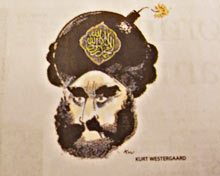
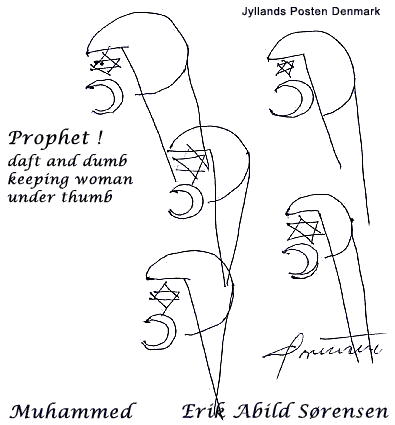
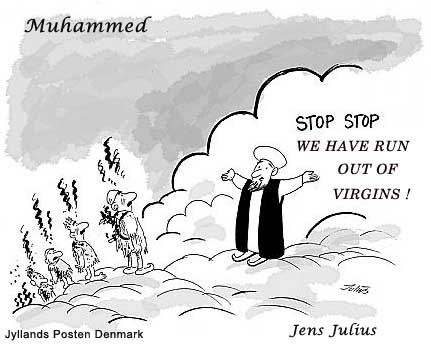
As a service to free speech, dcat presents the following images, via Seb's Blag:


By the way, I think Seb (whom I do not know, to my knowledge) sums it up pretty well: "Personally, I'm sick to death of seeing rampant militant Islamic extremists hijacking the headlines. Tolerant Muslims, I have all day for. Extremists can fuck off."


UPDATE: Fellow dcatter Roger writes something in the comments and contributes a link that deserves amplification:


I've come across this site, which is an archive of depictions of the prophet over the past several centuries, including the recent cartoons. It is interesting that cartoons depicting the prophet published over in recent years have not drawn anything like these protests, until such images are published as a deliberate defense (spelled right just for you dcat!) of freedom of speech and expression.

On The Bedside Table (Special Back To School Edition!)

It's been a while since we've had dcat's special books issue, "On the Bedside Table," where dcat writes bried blurbs about the books occupying that special place in his mind, heart, and boudoir. This edition will be devoted to the beginning of a new semester. Term time means that my reading habits change -- I assign a fairly heavy amount of reading, much of which stems from recent literature, so that always occupies a good amount of my reading time. I will follow this up with a post on the books I picked up in Africa.


The beginning of a new semester is always fresh and exciting. This one is no different. I am teaching three great classes, seem to have a pretty solid batch of students, and assigned some great books. I am most excited about my graduate seminar, Modern America, which I constructed around the theme "Liberalism, Conservatism, and Modern American Politics." I assigned seven books for this class:


Lewis Gould, The Modern American Presidency
Gregory Schneider, Ed., Conservatism in America Since 1930
Jonathan Schoenwald, A Time for Choosing
Alonzo Hamby, Liberalism and Its Challengers
Alan Brinkley, Liberalism and Its Discontents
Kevin Mattson, Intellectuals in Action
Lisa McGirr, Suburban Warriors


With the exception of Kevin Mattson's and Lisa McGirr's books, we will be reading sections of several books a week (on consecutive weeks mid-term we will read Mattson followed by McGirr.) I have organized the course chronologically and basically through the lens of national politics, with important exceptions. I use Gould to provide them with both an overview of the presidency in the twentieth century, but also to introduce them to an argument about modernization, for better and worse, in the executive branch. Schoenwald and Schneider serve the purpose of getting them to think seriously about conservatism while Hamby ("The Man," for those of you coming to us from Big Tent) and Brinkley will have them do the same about liberalism. Since they read these books in an intertwined fashion, the movements can talk to one another and neither gets more emphasis than the other. Mattson and McGirr provide insight into particular moents in the emergence of modern liberalism and modern conservatism respectively.


I am also teaching an upper division course in American history, US History 1877-1929. In it we are reading:


Michael McGerr, A Fierce Discontent
Frank Deford, The Old Ball Game
James Chace, 1912
Nathan Miller, Brave World Coming


For this class I try mto cover a broader thematic range. For those of you who know me and my work, there should be no surprise that I try to get them to think about sports as something more than a diversion. I figured that the Deford book would be useful on that point, giving them a sense of the era through a very readable, if not analytically deep, book. McGerr's book on Progressivism is vital, but is also structured in such a way that it is great for discussions. (I just finished a class meeting with them ten minutes ago; they are a lot more into the chapters dealing with booze and sex than they are on the anthracite coal strike of 1902. Funny that.) Chace's book on the 1912 election will bring one of the most fascinating political contests in American history to life for them, and Nathan Miller's book is one that I am just testing -- we'll see how it works.


Finally, in my modern Africa class, which in our latest overhaul of the major we turned from a 4000-level class to a 2000-level survey, we are reading:


Bill Berkeley, The Graves Are Not Yet Full
Adam Hochschild, King Leopold’s Ghost
Martin Meredith, The Fate of Africa
VS Naipaul, A Bend in the River


Meredith's is a big, important book that came out over the summer and that serves as the closest thing to a textbook, though it is not at all "textbooky." Berkeley's book is one of my favorites, is beautifully written, carries an interesting argument, and is the one book I have repeated each time I have taught this class. (I almost always use wholly new reading lists in my classes, if only to keep my engagement level up.) In fact, when people ask me for one book to read to "understand Africa," Berkeley's is where I send them. Hochschild's book on the horrors of the Belgian Congo is magnificent. Meanwhile, Naipaul's novel gives the students a chance to grapple with issues while at the same time getting to see how novels can both enlighten history while at the same time carrying with them limitations.


So there is your Spring 2006 reading list. Coming up, more Africa books.

Thursday, February 02, 2006

Oscar Nomination Commentary, Sort Of

I have to admit, in the frenzy of getting caught up from my trip and starting a new term and trying my damndest to hit a couple of book deadlineas and to get some seriously accruing other work done, I have not been able to see Munich yet. You may recall that in December I read Leon Wieseltier's review and was somewhat worried. Well, it seems that Spielberg recently described his critics as "fundamentalists." That really pissed off Mr. Wieseltier. I think that maybe pissing of Wieseltier was a mistake, as you can see from Wieseltier's response. Ouch.


As for the Academy Award nominations, I have to admit, I have not seen as many of the movies as I have wanted to, at least in part because so many saw their release come as the end of the year. "Good Night and Good Luck" was wonderful, and I am a bit shocked by all of the critics of its politics, the majority of whom admit to never having seen it. GNaGL is certainly not an apologia for communist inflitration of government, Hollywood, or anything else. But it is condemnation of a particular kind of smearing in which people were attacked and accused without evidence and where the very real threat of communist infiltration was not quelled as a result. My criticisms of McCarthy, and more importantly, his ilk, was not their goal, but rather their means, and perhaps more significantly, their incompetence. That there were real communists and a real communist threat is not up for serious debate. But that quite literally becomes almost irrelevent in the face of a communist scare that did little actually to bring those communists to light. (For what it's worth, this is one of my biggest problems with the Bush administration -- not its goals, but its means, and its competence and cynicism.)


The best thing about the DVD age is that most of the nominated movies are already available and I can watch them at home, or are still in theaters and I can go catch them on the big screen. In theory I am pleased with the fact that so many of the nominees are tied to historical films. But that a film is historical is not enough to make a historian happy. We actually want some sense of integrity to historical events as well.

Wednesday, February 01, 2006

"That'll Shut You Up": (Inside Joke Edition)

Over at Slice of Life, my boy Rich tells a story about our foolproof airport security system. In your life you learn that there are friends you'll walk through the storm with and those you would not trust to be able to do so. It's safe to say that Rich falls into the stand-up category. Ask us over beers about The Nibsy Shuffle and its aftermath. Good times. At least in retrospect.

Ass Man

South Africans are understandably outraged over the punishment given to a teacher who tried to sign his name on some of his female students' buttocks. He received three years of correctional services supervision. According to one of his students (and yes, while I cannot help but find this funny, the girls were 12-13 years old, so it is also more than a bit creepy):
"He was telling us that he was very determined to put his signature on our bums."


The 34 year old teacher, Mafa Chauke, will also be blacklisted from the teaching profession in South Africa. We should probably credit the crack investigation unit in Port Elizabeth for getting to the bottom of this. (Sorry. So sorry.)